Blog Directory CineVerse

A case of "he said, she said"

Wednesday, September 28, 2022

Steve Martin was one of the first of the early Saturday Night Live squad to parlay his comedic skills into a long-standing big-screen career. By 1984, he was established as a popular film funnyman, already appearing in three laughers directed by friend Carl Reiner. Their fourth collaboration was All of Me, a sometimes silly but often hilarious and heartfelt body swap comedy that many fans hold dear to their funnybone. Last week, the CineVerse group scrutinized this picture and determined if it still holds up or has lost its luster nearly 4 decades later, as detailed in our shared notes below (Click here to listen to a recording of our group discussion).

What is distinctive, surprising, or memorable about All of Me?

  • The success or failure of the picture rests primarily on Steve Martin’s shoulders. He has to convince us with his physical comedy and humorous talents that he is truly possessed by a woman. Consider the challenges of pulling this off: He has to consistently and believably portray a male character on his left side and a female character on his right side, with respectively different mannerisms, idiosyncrasies, and gender-driven personality traits that contrast. That makes this a remarkable performance, even if you don’t care for the movie or fail to find it funny.
  • If you perceive a sexual dynamism and chemistry between Martin and Victoria Tennant (who plays Terry), your instincts would be correct. The actors met on the set of this film and quickly began a romantic relationship that led to an eight-year marriage.
  • Arguably, despite its faults, All of Me can leave you feeling satisfied. Perhaps that’s because it hews closely to the tenets of a nearly foolproof subgenre: the screwball comedy, in which a moral lesson is often conveyed, flawed characters are redeemed, and quirky personalities add color and depth to the story. This film may not be the funniest motion picture you’ve ever seen, and at times it’s exceedingly preposterous, but you can’t argue that it’s sweet and sincere – the opposite of a gross-out comedy or meanspirited laugher that may make your belly sore from all the big yuks but which leaves you feeling hollow and uncaring about any of the characters.

This film falls firmly within the screwball comedy subgenre. What are some traits and characteristics of classic screwball comedies?

  • Farcical stories and situations—where the film pokes fun at stereotypical characters, such as fatcat filthy rich personalities and spoiled rotten daughters.
  • Fast pacing in the humor and repartee, direction, editing, and dialogue delivery.
  • Physical humor, including slapstick, pratfalls, and sight gags, often used to elicit major laughs and make dignified characters look ridiculous.
  • A plot centered on courtship and marriage or remarriage.
  • Themes highlighting the differences between upper and lower socioeconomic classes, with many of the settings taking place among the high society but involving a likable male love interest from the other side of the tracks.
  • A female lead who is often strong-willed, determined, and sometimes tomboyish, commonly depicted as stronger and even smarter than her male counterpart.
  • A story involving mistaken identity, misunderstanding, or the keeping of an important secret, occasionally involving cross-dressing or masquerading.
  • A classic battle of the sexes between a man and a woman, with the male lead’s masculinity often challenged by a strong female love interest.
  • Colorful supporting characters with quirky personalities.

Major themes

  • Learning to coexist with and respect the opposite sex. Roger and Edwina are forced to share the same body, which creates physical, philosophical, and existential dilemmas that comment on distinct disparities between genders. Despite their differences, they find a way to collaborate and harmonize, ultimately falling in love. This film suggests that putting yourself in the shoes of an opposite-sex partner by demonstrating empathy and patience can make you a more well-rounded human being.
  • Choosing happiness over success. Roger ultimately learns that the cutthroat world of law isn’t as fulfilling as pursuing his greater love of music.
  • Opposites attract. The personalities and backgrounds of Roger and Edwina are as different as you can imagine. But through the course of the story, their characters undergo an arc of change for the better; each is humbled and learns to accept the other’s needs, wants, and preferences.

Similar works

  • Identity exchange comedies, including Turnabout (1940), Vice Versa (1947), Tootsie, and Victor/Victoria
  • Body swap comedies, including Freaky Friday, Big, Chances Are, Heaven Can Wait, Heart and Souls, and Being John Malkovich
  • Comedies featuring gifted physical comedians, including Charles Chaplin, Jerry Lewis, and Jim Carrey

Other films directed by Carl Reiner

  • Oh, God!
  • The Jerk, Dead Men Don’t Wear Plaid, and The Man With Two Brains – also starring Steve Martin
  • Fatal Instinct

Read more...

Looking at the "Past" through the lens of the present

Tuesday, September 20, 2022

If you are a self-respecting film noir fan, Out of the Past (1947) probably ranks high on your list of standouts in this genre. Last week, our CineVerse group probed carefully into this movie’s anatomy to better understand what makes it a superlative noir. Highlights of our discussion points follow (click here to listen to a recording of our group discussion; to hear the September Cineversary podcast episode on his film, click here).


How has Out of the Past stood the test of time? Why does this movie still matter 75 years later, and why is it worth celebrating?

  • Out of the Past perhaps hews closest thematically and tonally to the central tenet of noir: that its characters are destined for doom based on fatal flaws like greed, betrayal, jealousy, and desire. Put another way, this film could be the truest expression of great noir and what makes noir great, thanks in large part to its fatalistic philosophy and pessimism.
  • It also still matters courtesy of its clever screenwriting construction and hard-boiled wordsmithing, particularly the memorable dialogue and one-liners.
  • It has stood the test of time partially because the title itself, Out of the Past, is one of the best in the genre. This title is arguably most representational of the murky, ambiguous, and obscure nature of noir, suggesting a mysterious story in which bygone secrets or forgotten shadows emerge to engulf the present day.
  • It’s further worth celebrating for its clever, rhythmic, hard-boiled dialogue and snappy patter, which is often a major part of the delicious fun of noir. In Out of the Past, Jeff gets most of the great lines, typically delivered almost as a punchline to a setup line, as if he were the polished comedian opposite a straight man. For proof, consider some of the following exchanges:
    • “Is there a way to win?” “Well, there’s a way to lose more slowly.”
    • “Don’t you like to gamble?” “Not against a wheel.”
    • “Don’t you believe me?” “Baby, I don’t care.”
    • “Don’t you miss me? “No more than I would my eyes.”
    • “I don’t want to die.” “Neither do I, maybe, but if I have to I’m going to die last.”
    • “I lost her.” “She’s worth losing.”
    • “He was trailin’ you?” “Well, you don’t go fishing with a .45 in your hand.”
    • “Don’t you see? You’ve only got me to make deals with now.” “Build my gallows high, baby.”
  • Even the way the characters are named matters here, as monikers reveal interesting things about them:
    • Jeff’s surname Markham sounds like “mark him” and suggests a “marked” man who is fated to die.
    • The word “Moffat” perhaps makes us think of “Little Miss Muffet,” who was visited by a spider; Moffat herself becomes a spider woman femme fatale.
    • The name “Whit” conjures up its homonym “wit,” W-I-T, implying a man of sharp intellect and facetiousness.
    • Meta has multiple meanings; in ancient Rome, "meta" meant a column or post, or a group of columns or posts, placed at each end of a racetrack to mark the turning places. The character of Meta also appears at and signifies a turning point in this story. Additionally, in the world of chemistry, "meta" is actually a prefix designating the meta position in the benzene ring; benzene itself is a toxic compound.
    • Jeff’s former partner Fisher has a name that makes us think he’s fishing for something or is himself fishy.
    • Eels speaks for itself: a personality who operates in a slippery underworld and finds himself “underwater” and dead at the heels of Whit and his henchman.
    • Stefanos sounds a bit like Mephistopheles, Mephisto, a demon or evil spirit.
    • “The kid,” as he’s listed in the credits, remains nameless, and is deaf and mute, as if the dealings of these other shady characters have left him speechless and deafened him with their evil intonations; he stands as a silent cipher, merely observing what’s happening, and serves in a way as a surrogate for the audience.

What special qualities do director Jacques Tourneur, writer Daniel Mainwaring, and cinematographer Nicholas Musuraca bring to this picture?

  • Out of the Past benefits, as do we, from the confluence of key artists working at top form, especially Tourneur behind the wheel and the three M’s that propel this vehicle: Mainwaring, Musaraca, and Mitchum. This is the byproduct of great timing coupled with great talent.
  • Jacques Tourneur is primarily known for helming horror classics like Cat People, I Walked With a Zombie, Curse of the Demon, and The Comedy of Terrors, but this work proves how savvy he could be working in other genres.
    • Tourneur begins the film in an offbeat fashion, in broad daylight with a POV shot from the backseat of a car.
    • He and his collaborators are responsible for a fantastic montage in Pablo’s bar, when the camera sweeps left and dissolves into a camera sweep left of a subsequent night.
    • The scene where Kathy and Jeff rush back to her place to escape the rain is a Tourneur masterclass in sexual suggestiveness at a time of censorship; from offscreen, Kathy throws a towel that knocks over a lamp, turning the room dark, as the wind blows open the front door – shorthand in the 1940s for urgent and passionate sex that couldn’t be shown.
    • It’s also shrewd to have the characters mention Kathy Moffat well before she appears on screen, which makes her entrance more impactful, especially after we hear Whit say earlier, “When you see her, you’ll understand better.”
    • Furthermore, it’s impressive how the filmmakers weave symbolic visual props into this story, including the spiderweb-like netting we see on the beach and the imposing gate at Whit’s compound that makes it look more like a penitentiary portal: not-so-incidental objects that silently comment on the dangerous milieu Jeff is caught up in.
    • Admire, as well, how effectively the camera lingers unbroken on Kathy’s radiant face during close-up or more tightly framed kissing scenes with Jeff, which makes us see her from his gaze and better appreciate how entrancing she appears to him.
  • Many people believe this was a B-movie because it was made by RKO – a studio known in the mid-1940s for producing pictures on a tighter budget. But the evidence shows that the opposite is true, that Greer and Mitchum were being positioned as rising stars, that Douglas’ talents were lent from another studio, and that noir scribe heavyweight James M. Cain was enlisted for script doctoring.

How and why was this film crucial in launching the careers of Robert Mitchum, Kirk Douglas, and Jane Greer, and is this possibly Mitchum’s best role and performance?

  • Mitchum shines in other key portrayals, particularly as the stalking preacher in Night of the Hunter, as the sadistically violent Max Kady in Cape Fear, and as Philip Marlowe in Farewell My Lovely.
  • But his turn as Jeff Bailey is equally exemplary, especially considering how differently Mitchum embodies the antihero lead character in a noir compared to someone like Bogart, Burt Lancaster, John Garfield, or Robert Ryan might approach this type of personality.
  • Mitchum exudes an unforced sexual magnetism and employs a nonchalant aplomb in his speech, mannerisms, and body language that differentiates him from many contemporary actors in this genre. Noir expert James Ursini describes Mitchum in this role as having a fatalistic and stoic quality, which stands in contrast to the slick and aggressive style of Douglas as Whit.
  • It certainly helps that he possesses the chiseled features and physique of a man who can handle himself when the going gets tough. But it’s the sensitivity around the eyes that particularly pulls fans into Mitchum’s performance.

Is Out of the Past innovative or different in any way, especially compared to previous noir films?

  • Many noirs predominantly showcase nighttime scenes in gritty urban jungles using high contrast lighting that create oodles of dark shadows; interestingly, this film features plenty of daytime scenes in bright, sunny settings, including bucolic outdoor locations.
    • According to Bright Lights Film Journal critic Gary Morris: “Director Jacques Tourneur follows Hitchcock’s approach in finding terror in the everyday, in this case the majestic backdrops of Lake Tahoe and Puerto Vallarta. This is not to say there aren’t recognizably dark “noir” scenes, but, again as in Hitchcock, the darkness emanates mainly from within the characters. This gives even a scene shot on a bright afternoon at a woodland river an atmosphere of bleakness and horror, when a fishing trip ends in a gruesome murder. It also shows the limits of Jeff’s world. Finished with Kathie, he falls in love with a sweet girl from the town where he’s been hiding, but while most of their scenes together are shot during the day, in natural locations, it’s clear from their nervous, almost desperate exchanges that there are stronger, darker forces that will prevent them ever coming together.”
  • As mentioned earlier, the male lead here is laid-back, laconic, low-key in speech, sleepy-eyed, and coolly detached; many other noir male leads, often private eyes, are harder-edged, tougher, more violent, and more alert and attentive. Credit Mitchum with infusing a new casual style and attitude to this noir anti-hero archetype.
  • The movie uses real locations and natural settings for a more realistic, authentic look.
  • Like several other noirs, this one employs a flashback, which occupies nearly half the runtime; what’s interesting about the flashback is that (1) it primarily occurs in broad daylight, and (2) Kathie is depicted as more of what DVD Savant Glenn Erickson described as “an idealized love object. When the narrative leaves flashback mode, her aura vanishes…Kathie then elicits nothing but contempt from Jeff.”
  • Erickson further posits that the film “brought out the romantic side of noir in ways that previous tough-guy pictures had not. The characters are cynical, but the movie is not. It aches with a failed romanticism forever defeated by greed, jealousy, and pride… Out of the Past confronts us with the argument that romantic suicide may be the only way to live.”
  • Almost all classic noirs feature characters smoking, but this one seems to be trying to set records for how many coffin nails can be lit up and sucked in a 90-minute flick. Smoking, in fact, becomes a form of sparring.
    • Roger Ebert wrote: “Few movies use smoking as well as this one; in their scenes together, it would be fair to say that Mitchum and Douglas smoke at each other, in a sublimated form of fencing.”
    • Jeff immediately lights up a lucky even after the tensest of situations, such as following Kathie’s murder of Fisher and upon his theft of the tax files – simple physical gestures that imply nerves of steel.

Considering all the double-crosses and doppelgängers, affidavits and tax documents, and blackmailing and bluffing in the second half of the story, there’s a lot to keep track of. Should viewers try to keep up with the chess games being played here, or should they adopt the same approach one might take with The Big Sleep, where the machinations of the plot should be regarded as less important than the film’s look, characters, and vibe?

  • It may be best to regard the tax papers, affidavit, and even Eels’ missing body as Hitchcockian MacGuffins: objects that propel the characters and the plot but are relatively insignificant to the audience. In other words, we shouldn’t care too much about them or how they are intricately enmeshed in the story.
  • According to TCM Noir Alley host Eddie Muller, the details of the complicated plot in the second half aren’t as important as the fact that these schemes and betrayals serve as catalysts to reunite Jeff, Whit, and Kathie for a final reckoning.

What’s the moral of the story here? What themes or messages are woven into Out of the Past?

  • The inability to escape one’s past or fate. The whole story is set in motion by Whit’s henchman finding Jeff and dragging him back to dangerous people and locations from his past. Even though all three main characters are on the lam, they can’t outrun their previous transgressions and crimes. They lead duplicitous double lives, but their true natures and identities ultimately emerge, leading to their downfall.
  • Repeating past mistakes. We see both Jeff and Kathie repeat certain actions that they will later come to regret or that prove futile.
    • Jeff conspires, or pretends to conspire, with Kathie against Whit multiple times.
    • Kathie shoots Whit and then shoots him again later.
    • After Jeff and Kathie deceive Whit, Jeff returns to Whit twice before the end of the story.
    • And Jeff rendezvous with Ann twice, but they still don’t end up together.
  • A doomed love triangle: Jeff, Kathie, and Whit are all bound together and fated to fall. Debatably, however, the more fascinating relationship here upon closer inspection is between Jeff and Whit, who have in common the same femme fatale woman, a scathing hatred for each other, a private code they each abide by, and a sardonic, pessimistic worldview.
  • Fate and doomed destiny: Interestingly, Jeff proceeds in getting involved with Kathie and Whit and reinvolving himself with them despite being aware that he’s being double-crossed and framed. It suggests that he can’t help himself because of Kathie’s magnetism and an inherent fatal flaw.
  • Disloyalty and duplicity are irredeemable mortal sins far worse than murder, theft, blackmail, or other crimes committed by these characters. Betrayal ultimately leads to the death of Jeff, Kathie, and Whit.
  • Moral ambiguity: As Roger Ebert wrote: “The movie's final scene, between the hometown girl Ann and Jimmy, Jeff's hired kid at the gas station, reflects the moral murkiness of the film with its quiet ambiguity…As Jimmy answers Ann's question, is he telling her what he believes, what he thinks she wants to believe, or what he thinks it will be best for her to believe?”
  • Unanswered questions: Critic Glenn Erickson also wrote that the secret of Out of the Past's superior dialogue is that “no question is ever given a straight answer. It's always another question, or a smart remark insinuating something.”
  • The dangerous noir female and what this character personifies. Morris wrote: “(Kathie) embodies postwar fears that women, having contributed mightily to the war effort and moved into ‘men’s work,’ might abandon the domestic sphere entirely, causing all manner of social mayhem. She’s the culmination of the self-consumed, anti-domestic, anti-social female as evoked by Stanwyck in Double Indemnity and Gene Tierney in Leave Her to Heaven, and even the most powerful men around her can’t comprehend or control the violent forces she represents.”

What is Out of the Past’s greatest gift to viewers?

  • One of this movie’s greatest gifts is that it’s a terrific story terrifically told, both visually and verbally. It’s true that the plot, particularly in the second half, becomes overly convoluted, especially as double-crosses and schemes both intersect and diverge. But what helps make it stand tall among other works in this genre is the way Out of the Past is supremely structured as a then-and-now story – featuring the extended and voiceover-narrated flashback comprising part one contrasting with present-day 1947 in part two, wherein the characters are continually haunted by the specter of the past.
  • Greatest gift number two is Kathy Moffat, quite possibly the sultriest and most sinister femme fatale of them all. Phyllis Dietrichson from Double Indemnity remains the cold-hearted queen against whom all other noir spider women are measured, certainly, but Kathy notches a higher body count of victims and wields her duplicitous charms with more skill and dexterity. Beauty is in the eye of the beholder, but like Rita Haworth in Gilda and Ava Gardner in The Killers, Jane Greer is drop-dead gorgeous, retaining a timeless allure and sensuousness 75 years later that makes viewers believe why Jeff would fall prey to her.
  • Greatest gift number three is the trenchcoat tough talk mouthed by these streetwise personalities: wisecracking witticisms and rapid-fire repartee delivered with a rhythm, cadence, and timing that can be relished by new generations as priceless pulp poetry. Out of the Past boasts some of the most stylized and sarcastically savory banter heard in a 1940s film. I submit to the jury the following exhibits:
    • “What was left of the day went away like a pack of cigarettes you smoked.”
    • “You’re like the leaf that blows from one gutter to another.”
    • “Do you always go around leaving your fingerprints on a girl’s shoulders?”
    • “Joe couldn’t find a prayer in the Bible.”
    • And perhaps my favorite: “You know, a dame with a rod is like a guy with a knitting needle.”

Read more...

TCM's Eddie Muller returns to Cineversary podcast to celebrate Out of the Past

Wednesday, September 14, 2022

For Cineversary podcast episode #51, host Erik Martin takes a trip down film noir boulevard to revisit Out of the Past, directed by Jacques Tourneur, which turns 75 this autumn. Joining Erik this episode is Eddie Muller, the host of TCM’s Noir Alley and author of Dark City: The Lost World of Film Noir. They navigate through this classic film’s cigarette haze and dark labyrinth of double-crosses to examine why Out of the Past stands the test of time, how it’s unique among noir fare, and why it’s worth celebrating.
Eddie Muller


To listen to this episode, click here or click the "play" button on the embedded streaming player below. Or, you can stream, download, or subscribe to Cineversary wherever you get your podcasts, including Apple Podcasts, Spotify, Stitcher, Castbox, Google Podcasts, Pocket Casts, PodBean, RadioPublic, and Overcast.

Learn more about the Cineversary podcast at anchor.fm/cineversary and email show comments or suggestions to cineversegroup@gmail.com.

Read more...

Identity theft in 16th century France

Tuesday, September 13, 2022

If you think it’s easy for bad actors to commit identity theft today, just imagine how simple it might have been hundreds of years ago, before photographs or recorded media could be used to help verify the authenticity of a person suspected of standing in for someone else. That’s a major part of the dilemma at the heart of director Daniel Vigne’s The Return of Martin Guerre, a French period piece that depicts one of the most famous cases of imposture in history, starring Gerard Depardieu. The CineVerse faithful took a deep dive into this picture last week; here’s a recap of our talking points (warning: spoilers ahead; to listen to a recording of our group discussion, click here).

What did you find impressive, unanticipated, noteworthy, or distinctive about this film?

  • The movie is well cast, boasting an array of skilled actors who imbue their parts with credibility and authenticity.
  • Perhaps the story is that much more fascinating because it is introduced as a true one.
  • The filmmakers don’t build intrigue by keeping the identity of Arnaud du Tilh secret until the end; there are hints that this man claiming to be Martin is a phony early on. Instead, we are enthralled more by the question of if and when he will be exposed and his deft ability to deceive the villagers.
  • It straddles the line between different genres and subgenres, including a historical period drama, a courtroom drama, a folk tale, a romance, and a moral parable.
    • Film Threat reviewer Hunter Lanier wrote: “There are many ways to tell this story. Vigne, very wisely, opts for all of them. As a result, you never feel confident as to what kind of movie you’re watching, which leaves you in the same state of confusion as the characters. In a similar fashion, Vigne doesn’t push the story into a particular thematic class but presents Martin, Bertrande, Pierre, and the townsfolk as lab rats in an experiment.”

Major themes

  • A moral quandary: to embrace a more pleasing and amiable imposter or to accept the unlikable but authentic original.
    • Considering how cold and uncaring the real Martin Guerre was to Bertrande, it’s not surprising that she would prefer the more attentive, literate, and popular charlatan over her real husband.
    • It also makes sense that the uncle and the townspeople would bury their doubts and accept this prodigal version of Martin in their community, as he seems more affable, attractive, social, and hard-working.
  • The parable of the prodigal son as a cautionary tale. The Bible story of the prodigal son teaches a lesson of forgiveness and love: that the father, or God, will welcome us back with open arms even if we have abandoned our family for years. But this cinematic twist on that tale suggests that there are risks in doing so blindly.
  • Clever playacting and masquerading. Even though there isn’t much doubt about the real identity of the fake Martin, it’s fascinating to watch this imposter at work, particularly his acting and verbal talents at persuading others.
  • The gullibility and naïveté of the masses. Arnaud’s ability to fool the relatives and friends of Martin speaks to how easily they can be persuaded and duped.

Similar works

  • Sommersby, a 1993 remake
  • Rashomon
  • No Man of Her Own
  • The House on Telegraph Hill
  • The Chameleon
  • The Affair of the Necklace
  • Bernie
  • The Imposter (2012 documentary)

Read more...

High Life lessons

Tuesday, September 6, 2022

What do black holes and  the future of the human race have in common? Director Claire Denis explores this and other answers in her decidedly dark and different sci-fi cinematic treatise High Life, starring an underrated Robert Pattinson. Our CineVerse homework assignment last week was to further investigate this puzzle box of a picture, which yielded several insights and observations, detailed below (to listen to a recording of our group discussion, click here).

What makes High Life memorable, unexpected, distinctive, and surprising, especially compared to other science fiction films you’ve seen?

  • This narrative is kaleidoscopic and elliptical, bouncing around in time and space in a nonlinear fashion – telling its tale through plentiful flashbacks of scenes on the ship as well as visual snippets of the characters as their younger selves back on earth. With this curious storytelling approach, the filmmakers challenge viewers to piece together the plot and try to understand character motivations and contexts.
  • There are no sci-fi visual clichés or predictable scenes. The ship looks nothing like we’ve observed in previous outer space depictions; the vessel’s rooms, corridors, and equipment don’t necessarily appear futuristic or state-of-the-art; many interiors are dim and dingy; we see no space battles or extraterrestrials; and, at least until the last scene, the characters aren’t in awe of their interstellar vistas or discoveries. Instead, the focus is primarily on the flawed human beings aboard the spacecraft versus any technological marvels.
  • The score is hauntingly dissonant and nontraditional, using synthesizers that provide a musical undercurrent as well as a tonal sound design.
  • Additionally, this is a thinking person’s science fiction film. Far from being popcorn entertainment, it’s a work that postulates ideas and key questions about humanity, existentialism, and our fate as a species.

What questions arise and remain unanswered after watching High Life (caution: spoilers ahead)?

  • Why is Dr. Dibs allowed to conduct these experiments on the ship?
  • Why does Dr. Dibs apparently have more authority on the ship than the captain?
  • Why does the ship resemble a box with no curves?
  • Why does Boyse kill the pilot Nansen to voluntarily enter the black hole?
  • Why does Dr. Dibs commit suicide?
  • Why are dogs the apparent only survivors on the identical ship?
  • Is Monte committing incest with his daughter?
  • Why would Monte and Willow want to head into the black hole?
  • What’s happening back on earth?
  • How are we to interpret the ending?

Major themes

  • The laws of nature versus the laws of man. Recall how Monte says: “Break the laws of nature and you will pay.” This film explores how imposing man-made rules in a restrictive environment clashes with our natures and can lead to violence and transgression.
    • New Republic reviewer Jo Livingstone wrote: “Rape, sewage, prison, violence, scars on the belly: High Life is a film about the aspects of existence that we keep hidden, because if they were not repressed they might take over the world. But are those natural laws, or man-made limits?”
  • Committing taboos that violate the rules. These humans are on the ship because they have committed taboo acts that landed them in prison. We also witness most occupants on the ship commit forbidden/offensive acts or express the desire to do so: rape, murder, physical assault, and possibly incest.
    • BFI critic Erika Balsom wrote: “In this film of bodies and power, Denis probes the force of prohibition and the inevitability of transgression. High Life is a thought experiment: what happens when the rules that govern life are suspended or breached? When are these rules necessary safeguards for collective existence and when are they cruel infractions of personal freedom? Who gets to decide? Taboos seek to protect the body politic, but they also exert a regulatory force. Their refusal can yield to emancipation, but equally to exclusion and punishment.”
  • Futuristic challenges involved in perpetuating the species. If human life on earth is inevitably doomed and we are forced to exist in outer space, this film argues that successful fertility and reproduction and enforcing rules related to them will be difficult due to scientific limitations and the selfish and violent nature of human beings.
  • Sexual desire and its expression is the last true freedom any prisoner has. Despite imposing laws on the convicts related to sexual activity, their base desires cannot be completely suppressed.
  • Paradise lost. Even though the crew has a healthy, vibrant, and picturesque garden on the ship that provides sustenance and oxygen, it’s a cruel reminder of the beautiful natural world these humans have left behind on earth. Like Adam and Eve, they’ve been cast out of the garden of Eden and are now forced to live in exile far removed from their natural homes.
  • Exploring a spiritual heart of darkness. The ship is on a mission to investigate black holes and attempt to extract power from them, but black holes serve as a metaphor here for the darkness in these characters’ souls and the uncertainty and unknown that awaits them.
  • Have human beings truly evolved, and are they capable of coexisting and remaining civilized in futuristic environments?
  • The consequences of recycling human beings. This movie examines the often ironic risks and rewards of attempting to repurpose human lives for a different role or objective.
    • Dr. Dibs killed her own children back on earth but is now attempting to become a Darwinian fertility queen/sex warden in outer space, with mostly disastrous results, although her efforts have produced one triumph: the birth and life of Willow.
    • Monte has chosen celibacy but is raped and later forced to raise Willow – an offspring he didn’t intend – on his own.
    • Boyse kills Nansen and attempts to pilot a vessel she was not trained to use, possibly resulting in her spaghettification death in the black hole.
    • Tcherny chooses to be buried in his beloved garden, which means he will now serve as fertilizer for the plants.

Similar works

  • 2001: A Space Odyssey
  • Solaris
  • Interstellar
  • Alien
  • Outland
  • Silent Running
  • The Martian
  • Under the Skin
  • Moon
  • The World, the Flesh, and the Devil
  • Ex Machina

Other films by Claire Denis

  • Bastards
  • Beau Travail
  • Chocolat
  • Trouble Every Day
  • White Material

Read more...

High wire comedy

Tuesday, August 30, 2022

Charles Chaplin certainly made more popular pictures (The Great Dictator) and more critically acclaimed films (City Lights) than his 1928 feature The Circus. But arguably he never made a funnier one, as the latter is practically bursting with side-splitting gags, hilarious set pieces, and unforgettable comedic stunts. Our CineVerse homework last week was to head to the big top and revisit this 94-year-old laugher and assess what makes it timeless (to listen to a recording of our group discussion, click here).
 

What is it about the Little Tramp character that we identify with and enjoy? What’s the secret behind this character’s appeal?

  • The Little Tramp is kind of an everyman—a surrogate for the audience on a journey, quest, adventure, or experience.
  • He’s a likable underdog because he is diminutive, often surrounded by bigger and stronger but not always smarter men.
  • Because the humor is often self-deprecating, making the Tramp the butt of jokes and a subject of humiliation, he makes us feel sympathy and empathy amidst the comedy. Indeed, he evokes a range of emotions from the viewer, which makes Chaplin a powerful and effective filmmaker and his Little Tramp so memorable. Some argue that Chaplin’s sensibilities are overly sentimentalized, that there’s too much pathos and maudlin mushiness in his movies—especially compared to his contemporary filmmaker/performer Buster Keaton. Others feel Chaplin hits the perfect emotional chords to leave us feeling satisfied by the end of the picture.
  • The key to appreciating the Little Tramp, however, is to realize that the inherent charm and humor come from presenting a cartoonish character who always tries to maintain dignity, pride, normalcy, and virtue despite repeatedly being embarrassed, belittled, overlooked, mistreated, and not taken seriously and despite his impoverished look and condition.
  • He also expresses a gallantry, civility, sincerity, and romantic sensibility that make you root for him.

What is memorable, distinctive, or significant about The Circus and Chaplin at this time (1928)?

  • It’s somewhat of a miracle that the film got made at all, considering that his 17-year-old wife was suing him for divorce; sordid details of his sex life were being leaked to the press, including tidbits about his affairs with other actresses, and that his wife claims he tried to pressure her into performing oral sex on him; his finances and properties were frozen during the court case; he was sued for over $1 million by the government for back taxes; the circus tent set burned to the ground; and he had to reshoot the entire tightrope scene after a month’s worth of takes of this sequence were damaged.
  • Comedically, the picture is almost too good to fail, loaded with riotously funny bits and escapades, including the pickpocket chase, house of mirrors scene, encounter in the lion’s cage, being chased by the angry donkey, auditioning for the Ringmaster, the ruining of the magician’s table, and the tightrope walking ending with the monkeys. Arguably the funniest sequence is when the Tramp turns into an automaton and robotically konks the pickpocket on the head while rhythmically emitting wide-mouthed laughs.
    • Criterion Collection essayist Pamela Hutchinson wrote: “What elevates the gag on the level of humor is not just the fact that he draws his victim into the same stunt, and duly bashes him on the head, but that the Chaplin-puppet roars with silent laughter as he does so. The put-upon Tramp reveals his cruel streak, knowing he has already captured our sympathy. As Tom Gunning puts it, Chaplin’s art resides in his ability to “metamorphose from one physical identity into another”: here, the Tramp transforms from victim to villain, from human to machine and back again.”
  • The scenes with the animals, including the shots inside the lion’s cage and the images of the monkeys biting his nose and climbing all over him are truly incredible, as are the shots of him walking the tightrope while suspended via wire and harness; it might have actually been easier to walk the rope without being suspended than to pull off the acrobatic, physics-defying feats Chaplin attempted.
  • A significant motif in the film is a circle, as evidenced by iris openings and closings, trapeze rings, the paper hoop Merna emerges from, the spinning treadmill platform, and even the circle he sits within at the conclusion.

Major themes

  • Ironic fate. The Tramp is funny only when he isn’t trying to be and has lost his dignity; but when he attempts to be comical, such as when auditioning for the Ringmaster, he isn’t funny. Because of his poor timing and clumsiness, he seems destined to be a circus star.
  • Pluck and perseverance aid the underdog. The Tramp is an overlooked, overmatched afterthought of a character to those around him, but he survives and thrives despite challenges from the law, bullies, and the animal kingdom because he’s resourceful, quick-witted, and downright lucky.
  • Spontenaiety, improvisational skills, and thinking on your feet are crowd-pleasing traits. The circus attendees are bored with the usual routines, but as soon as the Tramp appears in an unplanned and unrehearsed manner, they reward him and the Ringmaster with applause.
  • Sacrificing for the greater good. The Tramp realizes that he’s no match for the tightrope walker, who has captured Merna’s heart; he abandons his attempts at wooing her and plays matchmaker to the couple instead, ultimately choosing not to join the circus troupe on their tour.
  • Fear of falling, failing, and obsolescence.
    • Film historian Jeffrey Vance said in an interview: (Chaplin) “joins the circus and revolutionizes the cheap little knockabout comedy among the circus clowns, and becomes an enormous star. But by the end of the movie, the circus is packing up and moving on without him. Chaplin's left alone in the empty circus ring…It reminds me of Chaplin and his place in the world of the cinema. The show is moving on without him. He filmed that sequence four days after the release of `The Jazz Singer' (the first successful talkie) in New York.”
    • Hutchinson wrote: “The Circus is not just a film with a grand finale set on a high place, it’s a film about the pressure to be funny, about a man who can make people laugh only when he isn’t trying, and in which the identity of the Tramp himself begins to fracture… It’s not hard to read The Circus as Chaplin’s identity-crisis film, in which the idea of the great star playing ‘some little extra without a job or a place to live’ suddenly becomes too painful to bear.”

Similar works 

  • Safety Last
  • At the Circus (Marx Brothers)
  • The Artist
  • The Greatest Show on Earth
  • The Greatest Showman

Other feature films by Chaplin

  • The Kid
  • The Gold Rush
  • City Lights
  • Modern Times
  • The Great Dictator
  • Limelight

Read more...

Diving deep on "Sheep"

Tuesday, August 23, 2022

Charles Burnett may not be a household name like Spike Lee, but he’s unquestionably one of the most talented and respected African American directors. His breakout work, Killer of Sheep (1978), remained widely unseen for decades due to music rights issues, but it has been restored and is fortunately now accessible to millions. The CineVerse sleuths fine tooth combed this picture last week and arrived at the following observations (click here to listen to a recording of our group discussion).


What did you find interesting, unexpected, or memorable about Killer of Sheep?

  • There is no cohesive plot or structured narrative. Instead, the filmmakers present often disjointed vignettes in the lives of an economically challenged couple and their children and friends, with many sequences seeming unscripted and unrehearsed.
    • The film opens with a non sequitur of sorts: the scolding and physical punishing of a boy by his father and mother for not protecting his young sibling from a bully.
  • With its stark black-and-white canvas, gritty location shooting, and choppy editing, Killer of Sheep often looks and plays like a documentary as well as a work of cinema verite and neorealism. Italian neorealism, popular between 1945 and the late 1950s, was a film movement featuring movies set amidst the working class and economically disadvantaged that were shot on location and which mostly cast non-professional actors.
    • Roger Ebert wrote: “One scene follows another with no apparent pattern, reflecting how the lives of its family combine endless routine with the interruptions of random events. The day they all pile into a car to go to the races, for example, a lesser film would have had them winning or losing. In this film, they have a flat tire, and no spare. Thus does poverty become your companion on every journey.”
  • Likewise, the story doesn’t provide character arcs, moralistic payoffs, conquests, or predictable beats.
    • TCM reviewer David Sterritt wrote: “Burnett's decision to make Killer of Sheep was prompted by his intense dissatisfaction with movies that treat working-class life simplistically, solving complicated human problems in unrealistic and unimaginative ways, reuniting the couple, letting the team win, having the workers join a union – so everyone can bask in a happy ending. Burnett isn't interested in simple solutions, or even complex ones, because in his experience most real-life problems aren't resolved at all; folks just muddle through as best they can, and when one difficulty fades there's usually another to take its place. ‘What people are really struggling for is to endure, to survive,’ Burnett once told me, ‘to become adults and maintain some sort of moral compass.’”
  • There are no star actors; every face is fresh because we’ve not seen these performers before.
  • The soundtrack is outstanding, with the film benefiting from a variety of musical styles and African-American artists, including Dinah Washington, Etta James, Paul Robeson, Elmore James, Louis Armstrong, Little Walter, and Earth, Wind & Fire. In fact, this film’s widespread release was delayed for nearly 30 years because the filmmakers couldn’t secure the music licensing rights, and Charles Burnett wasn’t going to compromise and release a cut of the movie without these key songs included.
    • Adam Grinwald, a critic for Collider.com, wrote: “Burnett’s diverse selection of tunes works to help convey the movie’s wide pallet of emotions. It also serves as a bridge between the ‘high’ and ‘low’ cultures, just as the film itself works to combine classical filmmaking techniques with contemporary themes.”
  • Incredibly, Burnett created this film in the late 1970s for under $10,000, which demonstrates the power of resourcefulness, creativity, perseverance, and strong cinematic storytelling skills.
  • The picture remained mostly unseen by the masses for three decades, although it was among the first class of films to be entered in the National Film Registry in 1990 for its historical importance, it won the Critic's Award at the Berlin International Film Festival in 1981, and it ranked among the 100 Essential Films ever made by the National Society of Film Critics in 2002.

Major themes

  • Being stuck in a continual cycle of poverty, futility, and soul-crushing dissatisfaction. Stan is forced to work at a slaughterhouse, where he kills sheep, guts their carcasses, and preps the remains. Even the pastimes and off-work opportunities he engages in or considers only serve to keep him stuck on a metaphorical treadmill; he can’t make extra money fiddling with car engines; he doesn’t want to work at the local liquor store for fear of being robbed or shot; and he turns down his friends’ offer to participate in a revenge killing.
  • The struggles of the working class and inner-city families to get ahead, find fulfillment, and pass on happiness and a better future to their children. We witness how Stan, his wife, his son, and his friends are challenged by their economic circumstances and environment.
  • Times are hard for honest men. Stan is a father and husband with values and a strong work ethic, but he experiences hopelessness and powerlessness. Like a helpless sheep or lamb to the slaughter, he feels trapped in a predestined life of inevitable suffering.

Similar works

  • Italian neorealism films, including Bicycle Thieves, Rome: Open City, and Paisan
  • Song of Ceylon and Night Mail, directed by Basil Wright
  • The Southerner, directed by Jean Renoir
  • George Washington, directed by David Gordon Green
  • The early films of Jim Jarmusch and Richard Linklater, like Stranger Than Paradise and Slacker
  • Little Fugitive, which also depicts a particular time and place (New York in the mid-1950s) and is documentary-like

Other films by Charles Burnett

  • To Sleep With Anger
  • The Glass Shield
  • The Wedding
  • Nightjohn

Read more...

Ambersons aims high, despite its shortcomings

Monday, August 15, 2022

Eighty years ago, RKO Pictures released the follow up to Citizen Kane, Orsons Welles’s debut work that many consider the finest film ever made. Welles’ ambition was to top Kane by creating a picture that would visually astound, achieve new dramatic heights, and exceed the lofty expectations many had for his sophomore effort. But mixed reception from audiences during test previews propelled the studio to make drastic changes to the film while Welles was away in Brazil. Consequently, a shortened and thematically compromised version was released that flopped at the box office and damaged Welles’ standing in Hollywood. But despite its abbreviated runtime and deviation from the director’s intent, Ambersons has come to be regarded as among the greatest movies of all time.

Our CineVerse club convened last week to watch and discuss this flawed classic, and the highlights of our discussion are summarized below (to listen to a recording of our group discussion, click here).

Why does The Magnificent Ambersons still matter 80 years later? How has it stood the test of time, and why is this movie worth celebrating?

  • It could be Orson Welles’ best work, or at least might have been if not tampered with by RKO. Even in its altered form and with its tacked-on happy ending (which, by the way, approximates the finale in Booth Tarkington’s novel), it remains an incredible picture.
    • Welles’ intended finale featured Eugene visiting a diminished Fanny in a boarding house, which we learn in the final shot is actually the Amberson mansion. Tonally, this would have been a much more somber and elegiac denouement than the conclusion we currently have, in which Eugene and a healthier Fanny visit George recovering in the hospital where Lucy is by his side, the two men reconcile their differences, and it’s suggested that Eugene will financially provide for George and Fanny.
  • It has stood the test of time because it isn’t afraid to be dark and downbeat.
    • It’s prescient in its cautionary messages about how technological progress cannot be stopped and how industrial innovation and a faster-paced modern world has significant cultural and societal repercussions.
    • This is one of the first Hollywood motion pictures to tackle the topic of the rapid industrialization of early 20th century America and the replacement of the privileged aristocracy with the bourgeoisie, or upper middle class.
  • Ambersons further matters because many of the characters and performances are superb, especially Agnes Moorehead as Aunt Fanny. Some regard her portrayal as one of the first contemporary cinematic representations of a neurotic, hysterical woman.
  • Perhaps most of all it’s worth celebrating for the elite filmmaking craft involved, especially for 1942. Welles continued to experiment with the innovative approaches he and his collaborators first adopted in Citizen Kane, including:
    • Deep focus photography: Welles and company create striking compositions in which the frame is often carefully designed to feature multiple planes of focus and interest, such as in an early shot of the gossiping townspeople that layers them across the foreground, middle ground, and background.
    • Chiaroscuro lighting: The shadow-heavy cinematography is quite distinctive, with silhouettes and half-lit figures occasionally used to great dramatic effect.
    • Grandiose camera movement via elaborate crane shots and fluid tracking shots; a fine example of the latter is in the Ambersons ball sequence, where the camera seamlessly weaves between dancing and walking characters.
    • Long, unbroken shots: These keep the audience intently focused on the characters and the acting without breaking the rhythm of the scene or their performance, such as the four-minute sequence in the kitchen where Fanny feeds George, or Lucy and George’s carriage ride through town.
    • A sophisticated sound design: This is evidenced by the overlapping dialogue, variations in volume based on the speaker’s location to the camera, and echo effects.
    • Silent cinema techniques: In keeping with the nostalgic tone of the narrative, Welles employs antique effects like an iris closing and, in the prologue, a gauzy lens with blurred corners of the frame, harkening back to the look of silent movies and vintage photographs.
    • Creative end credits: Instead of using traditional text, Welles verbally recognizes the cast and crew and presents shots of the actors’ faces looking at the camera. I can’t recall another film that closes in this manner, can you?

How was Ambersons similar to and different from Welles’s previous film, Citizen Kane? What uniquely Wellesian qualities are imbued in this picture?

  • Besides the posthumously released Other Side of the Wind, this is the sole movie Welles helmed in which he doesn’t appear onscreen; only his narrating voice can be heard. His famously booming baritone takes a back seat here to a more subdued vocalization in which his cadence, timbre, and tone combine to convey a pensive and restrained omniscience.
  • Village Voice critic J. Hoberman wrote: “The film language is more fluid and adept than Kane‘s, the expressionist lighting is more rigorously modulated. The astonishingly choreographed Christmas ball that serves to introduce the major characters is arguably the greatest set piece of Welles’s career. The highly rehearsed ensemble…is sensational… not even Kane made more effective use of dramatic sound. Again, and with greater subtlety, there are Welles’s trademark overlapping dialogue and his construction of aural “deep space,” a brooding Bernard Herrmann score, and the clever deployment of a naturalistic Greek chorus. Most remarkable, however, is the voice…The movie is haunted by Welles’s voice, by his youth, and by a sense of a lost America that he would never again visit—and mainly by its own lost possibilities.”
  • While it’s a trifling point, this is an early example of a “meta” film in how it shares the same universe as Citizen Kane; if you pay close attention, you can spot how George’s automobile injury is reported in a newspaper story written by Jed Leland, Kane’s theatrical critic also played by Joseph Cotton.

Can you cite any films or filmmakers that you believe were influenced by The Magnificent Ambersons?

  • It’s possible that Hitchcock’s Shadow of a Doubt, released a year later, took a thematic cue or two from Ambersons in how it depicts the dark truths that fester inside a beloved small town.
  • Some cite Luchino Visconti’s equally nostalgic The Leopard as a work inspired by Ambersons.
  • Wes Anderson’s The Royal Tenenbaums was influenced, to some degree, by this film’s characters and story and even its title.
  • There was a three-hour cable version of this tale shown in 2002 that followed Welles’ shooting script—a testament to the allure of the lost cut of the film.
  • Welles himself revisited Ambersons’ class conflict and glory-fading themes in his later Chimes at Midnight.

What themes, messages, or morals are explored in Ambersons?

  • Time and progress cannot be halted. Most of the movie suggests that the Ambersons are doomed to financial failure, ignominy, and irrelevance because they cannot adapt to modernization and changing economic, social, and cultural paradigms. They can’t move forward, as Eugene symbolically does on the dance floor, whisking Isabel out of frame; instead, the Ambersons move backward, as George literally does when he dances with Lucy.
    • This implies that living in the past and ignoring what’s to come is dangerous. David Alexander of The Guardian wrote: “As modernity surrounds the Amberson mansion, Welles brings the film’s focus ever more tightly into the big old house. Soon we find we’re trapped there, entombed in an architectural anachronism. The last third of the film keeps the action largely in this setting, as it puts the Amberson family through a final round of humiliation.”
  • The negative consequences of innovation and technological progress.
    • This intimates that focusing only on the future while forgetting the past is dangerous, a concept contrary to the previously posited theme.
    • Remember how the narrator comments in the film’s opening, how “In those days, they had time for everything,” and how the streetcar is “too slow for us nowadays, because the faster we're carried, the less time we have to spare.” These remarks are prophetic, because nowadays, despite all our high-tech, rapid advancements designed to make life more efficient and easy, we seem to have less time than ever.
    • Also, recall what Eugene says after George’s insult about automobiles being a useless nuisance: “I'm not sure George is wrong about automobiles. With all their speed forward, they may be a step backward in civilization. It may be that they won't add to the beauty of the world or the life of men's souls…It may be that in 10 or 20 years from now, if we can see the inward change in men by that time, I shouldn't be able to defend the gasoline engine but would have to agree with George: that automobiles had no business to be invented.”
  • Nostalgia and wistfulness for a bygone time. Much of Ambersons is infused with a melancholic longing for a faded era, but the irony here is that staying wedded to the past keeps you blinded to the inevitable future and your ability to adjust to it.
    • Recall how Eugene says: “When times are gone, they are not old, they're dead. There aren't any times but new times.”
    • The problem for the Amberson clan is that they are solely focused on old times and past glories, which can be interpreted as the likely reason why, at least figuratively, Isabel dies prematurely, Jack is forced to leave town and look for work, Fanny faces financial ruin, and George is brought down several pegs.
  • Tragedy and misfortune. This is the tale of the downfall of a respected blue blood American family, as well as the unsettling transformation of a location from a beloved quaint hometown to an unsightly modern and mechanized city where past cherished charms have been swept away. It’s also a story of romantic catastrophe, in which a good man is prevented from marrying his true love, a spoiled offspring is jilted by the woman of his affection, and a meddling spinster doesn’t get the man of her dreams. And like a classic Greek tragedy, there is a Greek chorus of sorts in the form of the gossiping townsfolk we see.
  • Redemption and forgiveness. George is finally humbled in the end, forced to work for a living and found kneeling in prayer for forgiveness for his actions, which makes him a more sympathetic character. Poetic justice has been served in the form of an automobile accident that sends him to the hospital. This cosmic reprimand, combined with his mea culpa, means he is now worthy of being absolved by Eugene and loved by Lucy. And Eugene comes to pardon George for meddling in his affair with Isabel.
  • Complex familial dynamics and intergenerational struggles. There are three generations of Ambersons who face challenges in coexisting together. The naivete, rudeness, and stubborn nature of George—embodying the youngest generation—insinuates that the “magnificence” of the Amberson line is passing. However, his “comeuppance” and peacemaking with Eugene at the conclusion imply that George can redeem himself and his family’s name.
  • Class conflict. The Magnificent Ambersons is a study of the clash between gentry elites, represented by the Amberson family, and the upwardly mobile middle class that will replace them, exemplified by Eugene and his daughter.
  • Interesting romantic and familial dynamics.
    • Ambersons presents two unusual love triangles, the first between Isabel, Eugene, and George, and the second involving Lucy, Eugene, and George. The narrative centerpiece of this tale concerns the competition between George and Eugene for Isabel’s affection, but there’s also a thinly veiled Oedipal relationship between George and Isabel, who spoils her son. Likewise, Lucy has a close, if not Elektra-like, relationship with her father.
    • There’s an intriguing symmetry between several groups of characters, too. Ponder that Isabel is a widow with a son, just as Eugene is a widower with a child of his own. The widow and the widower are drawn to each other, as are their adult children. Two secondary characters include George’s paternal aunt and maternal uncle, helping to expand the intergenerational dynamics of this family story, with Fanny and Jack each getting roughly equal screen time.
  • Grievances, resentments, and unrequited love. Much of the plot and character motivations are propelled by emotional motives, such as the desire by many to see George get his just deserts; George’s umbrage against Eugene for the attention he gives to his mother and possibly because Lucy has rejected his affections; the jealousy Fanny harbors about Eugene and Isabel’s relationship; and the heartbreak Eugene endures multiple times when he is thwarted from being with Isabel.

What is The Magnificent Ambersons’ greatest gift to viewers?

  • One of the film’s greatest gift is that it demonstrates, even 80 years later, that tremendous talent, creativity, ingenuity, and artistry cannot be denied. Is Ambersons a blemished magnum opus because roughly one-third of its footage is missing? Yes. Would the narrative flow better and the character arcs feel more complete if Welles’s intended cut survived? Almost certainly. Would many of us regard Ambersons as a work equal to or greater than Kane if the missing 43 minutes were put back? Quite possibly. But as it stands, the uneven existing version remains a monumental achievement because of the undeniable quality permeating every frame. Even in this compromised form, the movie is simply too good to fail, thanks to the exceptional skills of its collaborators. The 88-minute version that survives isn’t merely “better than no version at all”; it’s better than the vast majority of motion pictures, period.

Read more...

Cineversary podcast rediscovers the magnificence of the Ambersons

Thursday, August 11, 2022

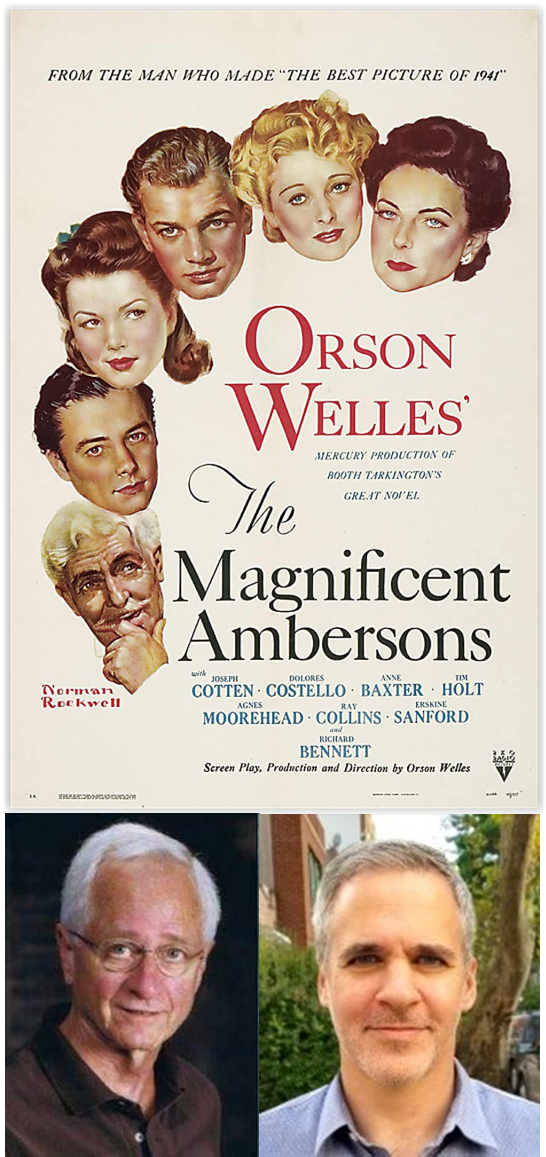
James Naremore and Joshua Grossberg
For Cineversary podcast episode #50, host Erik Martin revisits the magnificence of The Magnificent AmbersonsOrson Welles’ follow-up to Citizen Kane that marks an 80th anniversary this summer. For this commemoration, Erik partners with two outstanding guests: film scholar James Naremore, author of The Magic World of Orson Welles; and filmmaker Joshua Grossberg, director of the forthcoming documentary The Lost Print. Collectively, they discuss why The Magnificent Ambersons remains a cherished cinematic work, why RKO removed 43 minutes from the film and how it significantly altered Welles’ vision, and the search for this lost footage.

To listen to this episode, click here or click the "play" button on the embedded streaming player below. Or, you can stream, download, or subscribe to Cineversary wherever you get your podcasts, including Apple Podcasts, SpotifyStitcherCastboxGoogle PodcastsPocket CastsPodBeanRadioPublic, and Overcast.

Learn more about the Cineversary podcast at anchor.fm/cineversary, and email show comments or suggestions to cineversegroup@gmail.com.

Read more...

  © Blogger template Cumulus by Ourblogtemplates.com 2008

Back to TOP