Blog Directory CineVerse

Cineversary podcast marks 70th birthday of Hitchcock's Rear Window with Josh Larsen & Patrick McGilligan

Thursday, August 15, 2024

Patrick McGilligan and Josh Larsen
In Cineversary podcast episode #73, host Erik Martin marks the 70th anniversary of perhaps Alfred Hitchcock’s greatest work: Rear Window. Joining him for this installment is Patrick McGilligan, author of Alfred Hitchcock: A Life in Darkness and Light and an adjunct professor of film at Marquette University; and Josh Larsen, co-host of the Filmspotting podcast and author of Fear Not! A Christian Appreciation of Horror. Together, they take a telephoto lens to this movie and explore the craftmanship and thematic brilliance of Rear Window and its lasting influence.

To listen to this episode, click here or click the "play" button on the embedded streaming player below. Or, you can stream, download, or subscribe to Cineversary wherever you get your podcasts, including Apple Podcasts and Spotify.

Learn more about the Cineversary podcast at www.cineversary.com and email show comments or suggestions to cineversarypodcast@gmail.com.

Read more...

From Worst Person to best modern romcom

Tuesday, August 6, 2024

Want a 21st-century romcom done right? Look overseas, to Norway in particular, and the talents of director Joachim Trier, who helmed The Worst Person in the World in 2021. Starring Renate Reinsve as Julie, alongside Anders Danielsen Lie as Aksel and Herbert Nordrum as Eivind, it chronicles the life of a young woman in her late twenties navigating the complexities of love, career, and identity in contemporary Oslo. Over four years, Julie explores different paths in her search for meaning and fulfillment while dealing with significant personal and romantic challenges.

Reinsve's performance garnered particular praise, earning her the Best Actress award at the 2021 Cannes Film Festival. Trier's direction, along with the screenplay co-written with Eskil Vogt, was celebrated for its depth, wit, and emotional resonance. The film's honest depiction of the uncertainties and contradictions of modern life, especially regarding relationships and personal growth, struck a chord with many viewers, and the movie’s visual style and inventive narrative structure were recognized for their artistic merit.

Click here to listen to a recording of our CineVerse group discussion of this film, conducted last week.


The Worst Person in the World is a refreshing take on an overdone subgenre because it refuses to slip into cliches or predictable patterns we’d expect of millennial characters or manic pixie dream girls (the kind which you’d find in pictures like 500 Days of Summer, Scott Pilgrim Vs. the World, Garden State, or Eternal Sunshine of the Spotless Mind). It boasts a smart screenplay filled with realistic relationship dialogue and a narrative that diverges in ways we don’t expect. “If some films look to revivify a formula rather than reinvent the wheel, The Worst Person in the World may be the prime example of how to restore fun, significance, and even a little bit of sex to the well-worn terrain of the romantic comedy,” per Pat Brown and Derek Smith of Slant.

The narrative is bookended by a prologue and epilogue and divided into 12 curiously titled chapters, making the story play cinematically as a kind of book adaptation. The film also sporadically utilizes a third-person voiceover narrator who wryly and sardonically comments on the action or Julie’s internal world.

Worst Person features two wonderful fantasy sequences: One in which Julie experiences the hallucinogenic effects of mushrooms, and another where she imagines a perfect day spent with Eivind while everyone else is in suspended animation. The filmmakers also employ a montage sidebar in which we learn about Julie’s female ancestors. These sequences demonstrate how to infuse visual and emotional creativity into a contemporary romcom.

The title is interesting. We hear Eivind briefly refer to himself as “the worst person in the world,” but we know that he nor Julie fit that description (recall that they don’t technically cheat on their former partners). Still, it’s a moniker that suggests self-doubt, blame, and—because we don’t believe Julie to be the world’s worst human being—irony.

The film’s obvious strength is, of course, Reinsve in the main role, who is breathtakingly believable, vibrant, and magnetic, exuding a joie de vivre that’s undeniable and effortlessly expressing a range of emotions throughout the film. But the biggest scene stealer is perhaps Lie as Aksel, especially in the park scene after his cancer diagnosis, when he reveals much to Julie in a heart-crushing soliloquy.

Worst Person tells us not to be afraid to change lanes in life. Julie often changes her mind on careers, relationships, and life goals like whether or not she wants a family. While she can read as impulsive, flighty, or non-committal, this character embodies the concerns millennials and young adults today have with making the right choice in a world full of multiple options and avoiding the status quo or playing it too safe. Earlier, Julie says she feels “like a spectator in my own life,” which motivates her to think outside the box.

Choosing to live your best life and write your own story despite the consequences is another significant message. The Worst Person in the World preaches staying true to yourself and shaping your life’s narrative, especially while you’re still young, as opposed to letting society or tradition dictate your fate. It’s also about being willing to take risks that could lead to regret, disappointment, or ennui or that could result in greater happiness and fulfillment. Film critic Carlos Aguilar wrote: “For our transient time here—an inharmonious symphony of beginnings and conclusions, small triumphs and big disillusions, all without a grand design—perhaps the plans that fell through, Julie’s and ours, don’t matter as much. The value is in the bravery to see the crumbles of a former dream or a past relationship and still try again in earnest from scratch; to be aware that the same mistakes may come along and that growing pains may never vanish, to embrace that we are on nobody’s timeline but our own.”

Vox reviewer Alissa Wilkinson posited a similar takeaway. “Living well is hard, and sometimes you make mistakes, and the reasons might have less to do with you than with the infinite plethora of options the world presents to you,” she wrote. “If we’re lucky, life bestows choices upon us from our youth, but we’re rarely equipped with tools to tell which choice is best, or whether there’s even a best choice to make. It’s an existential dilemma unique to our time: presented with infinite prospects, yet paralyzed by the possibilities they represent. Choosing one thing or person or future means rejecting something else — an action, philosophers note, that can provoke a lot of angst. It’s enough to make you feel like the worst person in the world.”

Lastly, the film reminds us that life is short, fleeting, and unpredictable. The sudden terminal illness of Julie’s former lover Aksel reminds her of this truism, as does the happenchance return of Eivind into her life.

Similar works

  • The films of Woody Allen
  • Frances Ha
  • Jules and Jim
  • Amelie
  • The Before trilogy
  • While We’re Young
  • Marriage Story
  • Obvious Child
  • Reprise
  • In the Mood For Love

Other films by Joachim Trier

  • Reprise (2006)
  • Oslo, August 31st (2011)
  • Louder Than Bombs (2015)
  • Thelma (2017)
  • The Other Munch (2018)

Read more...

From highness to lowness

Thursday, August 1, 2024

Set over three days during the Christmas holidays in 1991, Spencer portrays Princess Diana's decision to end her marriage to Prince Charles. The film, directed by Pablo Larraín, written by Steven Knight, and released in U.S. theaters in late 2021, focuses on her existential crisis as Diana (played by Kristen Stewart) grapples with the constraints and expectations placed upon her by the royal family. The cast also includes Jack Farthing as Charles, Prince of Wales, Sally Hawkins as Maggie, Timothy Spall as Major Alistair Gregory, and Sean Harris as Darren.

To listen to a recording of our CineVerse group discussion of Spencer, conducted in mid-July, click here.


Spencer offers a more intimate and speculative look at Diana's life, focusing on a brief yet impactful period using a blend of factual and fictionalized elements. This is, right up front, called “a fable from a true tragedy,” and should be interpreted as such. Spencer is not intended as a bullseye-accurate biopic; it’s more of a reimagining of the not-so-secret consternation that Princess Di reportedly experienced before separating from Charles—much like director Andrew Dominik presented an alternate take on Marilyn Monroe and her inner turmoil in the 2022 film Blonde.

In sometimes unsubtle ways, Spencer veers into metaphoric flights of fantasy, as evidenced by several dream and imagination sequences that are not to be taken literally. Examples include Diana breaking her pearls during dinner and chewing on one of them, which doesn’t actually happen; a shot in which we see a self-inflicted cut that quickly disappears; and the princess embracing in a desperate hug who we think is Maggie only to learn that it’s a different servant.

Often, the filmmakers use obvious on-the-nose visuals to make thematic statements. Cases in point: Diana’s obsession with the old scarecrow, itself a symbol of loneliness and abandonment; quickly alternating shots of her walking in Ann Boleyn’s clothing and her own attire; her dropping of the billiard ball in front of Charles; and her donning of an OPP hat (short for “other people’s property”).

The score by Radiohead’s Johhny Greenwood, with its unnerving jazzy movements and screechy strings, creates an effective aural landscape of brooding uncertainty and rising tension.

The movie ends somewhat surprisingly on an upbeat note, as we see Diana temporarily abscond with her children and enjoy a getaway moment punctuated by a cheesy but appropriate pop song and greasy fried chicken. Instead of continuing to hammer us with ominous foreshadowing of her inevitable death or doubling down on depressing moments, Spencer concludes with a reminder that the late princess deserves to be remembered as a more rounded human being who was decidedly different from the royalty she married into.

It’s hard to overlook the “woman held prisoner in a gilded cage” trope, which constitutes most of the thematic weight of the film. Diana lives a life graced with unparalleled wealth and privilege, but suffers an existential crisis of captivity, claustrophobia, and lack of agency—feeling unloved, lonely, and stifled. But Spencer is also a treatise on rebellion against authority, tradition, and expectation. The princess is constantly seeking escape from the rigid restrictions and conventions of the royal family, and she repeatedly breaks the rules surrounding schedules, boundaries, regal etiquette, and decorum.

The picture also suggests that, although Diana would appear to be powerless, her nonconformity and small acts of agency represent a concerning threat to the nobility’s established order. New Republic critic Jo Livingstone wrote: “By letting Diana misbehave in such picturesque fashion, Larraín makes the idea of “princessiness” a source of alarming power…Always dissatisfied, like the princess who was so sensitive to a pea under her mattresses. A beautiful outsider, like Cinderella. A subversive princess who threatens the crown through her blood claim on her sons, like Mary, Queen of Scots. A girl who finds her own strength from within, and bucks convention’s chains, like Elsa from Frozen. In a director’s statement distributed among the press notes, Larraín writes that Spencer is “an upside-down fairytale.”

Another key takeaway? The burdening weight of history and ritual. Diana loathes the suffocating atmosphere of the royal estate, its timeworn customs, and the dark past of its bygone inhabitants, especially Ann Boleyn—a haunting figure of foreshadowing who was also abandoned by her husband and, as will happen to Diana in a few years, was violently killed. Diana says to her boys: “Here, there is no future, and past and present are the same thing.”

Spencer also reinforces the importance of finding joy in life’s simple pleasures. The princess is happiest when simply spending time playing or bonding with her two young sons or indulging in recreations that would be frowned upon by her upper-crust in-laws, including confiding in a beloved servant, feeling nostalgic about her childhood, driving for pleasure without a security detail, singing along loudly to pop music, or enjoying fast food.

Similar works

  • Diana
  • The Queen
  • Blonde
  • Elizabeth
  • The Favourite
  • Repulsion
  • Melancholia

Other films by Pablo Larrain

  • No
  • The Club
  • Neruda
  • Jackie
  • Ema

Read more...

How to balance "Valance"

Friday, July 19, 2024


The Man Who Shot Liberty Valance, a timeless American Western directed by John Ford and released in 1962, centers on Ransom "Ranse" Stoddard (James Stewart), a lawyer who gains fame for killing the notorious outlaw Liberty Valance (Lee Marvin). But as Stoddard recounts the story to reporters while in Shinbone for the funeral of his old friend Tom Doniphon (John Wayne), much more is revealed. 

Featuring standout performances from Stewart, Wayne, Marvin, Vera Miles, Edmond O'Brien, and Andy Devine, the film is highly regarded for Ford's exceptional direction, which seamlessly blends character development, storytelling, and visual style. Its thematic depth, extended use of a flashback narrative, and cultural impact, particularly the iconic line "When the legend becomes fact, print the legend," have made it a significant work in the Western genre.

Click here to listen to a recording of our CineVerse discussion of this film, conducted last week.


Valance deviates from other venerated Westerns, especially those made by Ford, in several ways. First, it was shot in black and white, something of an anomaly for a 1962 Western. For years, many movies in this genre by this had been filmed in glorious color, often in widescreen, showcasing the painted desert and epic scale of the Old West. Yet, grayscale is appropriate to enhance the murkiness and shades of grey inherent in this story and its characters; it’s also fitting considering that most of the film is told in flashback as if summoning up a bygone time, which black and white lends itself well to.

The movie is rather plain-looking, stagey, talky, and slowly paced, and is not an action/adventure oater. It casts two major Hollywood household names, but both Wayne and Stewart are debatably too old for the younger parts they’re supposed to be playing. This is also not a picture where the land and nature are characters unto themselves, and there’s no majestic Monument Valley of Ford’s past films. It’s more of an introspective character study.

Moreover, this work is less optimistic in tone than many of Ford’s previous Westerns; instead, Valance reads as elegiac, nostalgic, bittersweet, and mournful. Ironically, the cowboys are the bad guys: they’ve hired Valance and his cronies to threaten the townsfolk and pressure their political vote. The film’s tone could be echoing the feeling of the times, an era when the Cold War and Vietnam War were ratcheting up, which helps explain the dark, cynical vibe and cruel violence of the villain. Per DVD Verdict editor Michael Stailey: “For all of Stoddard's optimism that civilized law would prevail against the violent threat of Liberty Valance, he ultimately fails. The murder of Valance is, in fact, the only way to stop him, save Shinbone, and propel Stoddard to Washington D.C. The optimism once found in Ford's films is gone now, as is his sense of grandeur, and it has been replaced with the cold realism of a man who has seen enough to know better.”

Consider how this is a film that both glorifies the past and heroes of the West, yet also criticizes its injustices, cruelties, harsh realities, and racism (recall how Pompey is depicted as a puppet-like character who lives to serve, a peripheral personage who can’t even be served at the bar or permitted to vote).

Many regard this as Ford’s last completely realized work and his final masterpiece, benefitting from many of the director's signature techniques and stylistic tendencies, as remarked upon by Roger Ebert in his review of Valance. “(Ford’s) films were complete and self-contained in a way that approaches perfection. Without ever seeming to hurry, he doesn't include a single gratuitous shot… There is a purity to the John Ford style. His composition is classical. He arranges his characters within the frame to reflect power dynamics--or sometimes to suggest a balance is changing. His magnificent Western landscapes are always there, but as environment, not travelogue. He films mostly on sets, but we're not particularly aware.”

Upon closer inspection, it’s clear that Rance, Liberty, Tom, and Hallie are each representational of a greater message. Stoddard symbolizes the New West, one where the rule of law and the tenets of democracy will bring peace, justice, and civility to a growing society. He’s an idealist who isn’t afraid to not be macho. Valance, of course, is evil and fascism personified. 

Doniphon, meanwhile, signifies the Old West, where guns and violence were used to settle a problem and take care of the men in black hats. He’s a realist, and he knows that it takes more than courage and idealism to defeat the villain. Tom stands as the rugged individualist hero who, as in the Searchers, must sacrifice himself and remain outside a civilized society for that society to progress forward. TCM’s Rob Nixon wrote about Tom’s character: “As theorist Robert B. Ray has detailed, it can be taken as a perfect critical study of one of the most enduring of Hollywood tropes: the outlaw hero (Tom in Liberty Valance, Clementine's Doc Holliday, Rick in Casablanca, 1942) reluctantly drawn into cooperating with the "official" hero (Stoddard, Wyatt Earp, Victor Laszlo) to defeat a common enemy (Valance and the cattle interests, the Clantons, Nazis), usually for the mutual love of a good woman (Hallie, Clementine, Ilsa). Except the outcome in Valance is dark and painful. As some have noted about this story: The hero doesn't win; the winner isn't heroic. Destiny here is more a matter of accident and misunderstanding, and history depends entirely on who's telling it and why.”

And then there’s Hallie, who serves as a surrogate for the audience—the one whom the Old West and the New West are trying to woo. We, like she, are challenged with a choice: to place allegiance behind the values of the Old West or the New West.

The Man Who Shot Liberty Valance is, as you’d expect of a Ford film, chock full of thematic goodies. It’s certainly a story about the conflict between popular myth and warts-and-all reality, and action and violence versus tact and diplomacy or, put another way, vigilante justice versus legal justice. The first image of the film—an approaching train, which stands for progress—clues us into this schism and the idea that the New West is the fertile soil for growing civilized society. Yet the movie reminds us that, while change and advancement are necessary for the betterment of humanity, it’s essential to appreciate how this progress was achieved: by the blood, sweat, toil, and sacrifice of forgotten heroes and the common man.

Lastly, ponder how this picture also depicts a psychoanalytic battle between the id, the ego, and the superego, as personified by Liberty, Tom, and Rance, respectively. The id represents the impulsive aspect of your personality, seeking pleasure and avoiding pain. The superego embodies the judgmental and morally upright part of your personality. The ego, as the conscious part of your personality, balances the demands of the id and the superego, making decisions accordingly.

Similar works

  • The Searchers
  • High Noon
  • Destry Rides Again
  • Mr. Smith Goes to Washington

Other works by John Ford

  • Stagecoach
  • Young Mr. Lincoln
  • Drums Along the Mohawk
  • The Grapes of Wrath
  • How Green Was My Valley
  • My Darling Clementine
  • Fort Apache
  • She Wore a Yellow Ribbon
  • Rio Grande
  • The Quiet Man
  • Mister Roberts
  • The Searchers

Read more...

Cineversary podcast celebrates 60th birthday of A Hard Day's Night with Ken Womack

Wednesday, July 17, 2024

In Cineversary podcast episode #72, host Erik Martin is joined by guest Ken Womack—author of several books on the Fab Four including The Cambridge Companion to the Beatles and Living the Beatles Legend: The Untold Story of Mal Evans—as they celebrate the 60th birthday of A Hard Day’s Night, directed by Richard Lester. Together, they rediscover the euphoria of of Beatlemania, examine this film’s widespread influence, and explain why the movie still matters.
Ken Womack


To listen to this episode, click here or click the "play" button on the embedded streaming player below. Or, you can stream, download, or subscribe to Cineversary wherever you get your podcasts, including Apple Podcasts, Spotify, Audible, Castbox, Google Podcasts, Pocket Casts, PodBean, RadioPublic, and Overcast.

Learn more about the Cineversary podcast at www.cineversary.com and email show comments or suggestions to cineversarypodcast@gmail.com.

Read more...

Fab Four flashback: Celebrating 60 years of a Hard Day's Night

Tuesday, July 9, 2024


Anyone alive back in early 1964 remembers the pop culture phenomenon that was quickly dubbed “Beatlemania.” Events happened quickly in that year to catapult the Fab Four into the stratosphere as a worldwide sensation, particularly in America. The lads made their television debut in February on the Ed Sullivan Show, owned the top 5 positions on the Billboard Hot 100 chart in April, and released their first film in July.

Yes, it’s now been 60 years since A Hard Day’s Night first hit theaters, and it’s time to celebrate what could be the very best rock and roll film/jukebox musical ever made.

Click here to listen to a recording of our CineVerse group discussion of A Hard Day’s Night, conducted last week. (A Hard Day's Night will also be the subject of the July episode of the Cineversary podcast, posting next week.)  


Released in the UK on July 6, 1964, and in the United States on August 11, 1964, produced by United Artists, directed by Richard Lester, and written by Alun Owen, the film received widespread critical acclaim for its witty screenplay, dynamic direction, and—of course—the unforgettable Beatles performances that help this picture rank highest among the group’s cinematic oeuvre. Other contenders for greatest Beatles movie (films that feature the actual band or their likenesses) include Help!, Get Back, Magical Mystery Tour, Yellow Submarine, Let It Be, Eight Days a Week, and the Beatles Anthology TV series. But most fans and critics would likely vote for A Hard Day’s Night as the foursome’s finest moment on film.

Some also deem A Hard Day’s Night among the very best musical comedies, pop musicals, or musicals, period. The late Roger Ebert cited it as one of the top five musicals, ranking alongside Singin’ In the Rain.

Above all, this film benefits from absolutely perfect timing. It thrillingly captures a zeitgeist moment in 1964—the ascendance of The Beatles as a dominant musical and sociocultural force, just as they were conquering the world with pop hits and charismatic command. It wasn’t shot or released too early or belatedly; the film is a serendipitous beneficiary of a narrow window of time when Beatlemania exploded, and A Hard Day’s Night also helped fuel that explosion.

What makes it particularly special is that, although this is a scripted production, the footage looks impromptu and feels off the cuff as a documentary would. The mock press conference mimics the real press gathering in New York City in February 1964 that occurred just before principal photography, when the Fab Four charmed the media with their witty responses, and the scenes where they are chased by fans are authentic, as are the crowd shots of impassioned attendees attended their performances in the film. The filmmaker’s choice to shoot in monochrome gives it a newsreel/documentary quality, as well.

What also helps give A Hard Day’s Night staying power is its evergreen thematic resonance. Essentially, this film is about nonconformists against the establishment: The four are scoffed at, ridiculed, dismissed, and condescended to by older generations, and the Beatles parlay this disconnect into a cheeky, irreverent rebelliousness that isn’t too threatening to the social order.

Per the Village Voice’s J. Hoberman: “A Hard Day's Night presents a realm in which the Beatles (who are more or less the exclusive representatives of their generational cohort) appear to be the only sane inhabitants. On one hand, the foursome are skeptical children in a ridiculous adult world; on the other, as parents don't exist and the band's admirers are mainly preadolescent kids, the Beatles appear as that world's only possible role models and authorities.”

Significantly, A Hard Day’s Night isn’t just a one-trick pony where the sheer magnetism of The Beatles overshadows every other element. It continues to make us laugh 60 years onward thanks to humorously crafted bits, hilarious one-liners like Lennon’s “Give us a kiss” and “I now declare this bridge open”, and eternally funny visual comedy, such as the running gag of the grandfather popping up from a trap door floor at the worst moment, the older porter in his underwear hiding in the closet, and thief trying to steal the car as the Beatles are chased by the bobbies (once he breaks into the vehicle, a cop ironically orders the thief to drive after Ringo, George, Paul, and John).

Audiences also continue to enjoy how the movie humorously explores mistaken identity, disguises, and missing persons: From Paul’s grandfather posing as a waiter to John donning a fake beard and mustache to George wandering into a producer’s office where he’s mistaken for a focus group subject, playacting and identity misunderstandings abound in this playful romp. Recall how Ringo goes missing, as does Paul’s grandfather, and even the manager loses his band in a repeated pattern of lost-and-found subplots.

Far from merely a trivial pleasure or disposable cinematic confection, A Hard Day’s Night stands as an innovative work worthy of praise for its pervasive influence. This movie essentially invented what we consider “music videos” and the style of content that gave rise to MTV years later. The musical sequences, where songs were performed, shot, and edited in creatively and visually engaging ways, served as precursors to modern music videos, particularly the Can’t Buy Me Love segment.

Also, A Hard Day’s Night could be the first “mockumentary,” a subgenre that blends scripted scenes and fictional elements with a documentary-like style, which imbues the film with a distinctive sense of verisimilitude and immediacy for its time. Yes, a proper screenplay was written and followed, but The Beatles were permitted to improvise. The narrative is more of a loosely connected series of episodes and unimportant subplots that form a cohesive story.

Thanks to its rapid-fire editing, unconventional camera angles, frenetic handheld camera shots, cinema verite style realism, swish pans, crash zooms, fast and slow motion action sequences, and other elements, A Hard Day’s Night reveals a kinship with the bold experimentalism and liveliness of French New Wave cinema.

The film was also one of the earliest to capture and mirror the emerging youth culture of the 1960s. It portrayed the Beatles not just as musicians but as cultural icons, seamlessly weaving their music into the storyline. In addition, A Hard Day’s Night rendered a rare behind-the-scenes look at the lives of pop stars, blending humor with insights into the pressures and absurdities of fame. This was relatively novel and provided audiences with a sense of intimacy with the band.

Slate reviewer David Edelstein wrote: “A Hard Day's Night remains a pop-culture phenomenon: a movie with perfect feelers. Lester and his team pick up and distill everything in the air on the eve of the counterculture: now capturing events with documentary realism, now stylizing them with gleeful surrealism, always managing, by impishly flouting the rules of "proper" storytelling, to keep alive a sense of barriers being blasted…The film will always be in the present tense: a reference point not merely for the birth of the Beatles as a mass phenomenon, but for the emergence of a wildly attractive youth culture that has transformed the world.”

The movie is credited, as well, with inspiring the creation of The Monkee’s TV program, which debuted two years later, and—thanks in particular to its dynamic editing approach, pacing, and visual storytelling—spy thriller films over the next few years like Goldfinger, The Ipcress File, Modesty Blaise, and the TV series Man from U.N.C.L.E.

Films more directly inspired by A Hard Day’s Night include Ferry Cross the Mersey (1964, showcasing Gerry and the Pacemakers), Catch Us If You Can (1965, featuring The Dave Clark Five), Hold On! (1966, with Herman’s Hermits), Head (1968, starring The Monkees), I Wanna Hold Your Hand (1978), The Rutles: All You Need Is Cash (1978, another mockumentary that directly riffs on The Beatles), That Thing You Do (1996), and Spice World (1997, starring The Spice Girls).

Examining influences in reverse, it seems clear that A Hard Day’s Night and the personalities of The Beatles in this film riffs heavily on the Marx Brothers, with John zinging clever, acerbic put-downs and irreverent retorts in snappy fashion like Groucho and the Beatles invoking the anarchic and anti-establishment characteristics of the brothers Marx. Lester’s infusion of surreal, zany shots harkens to the films of Groucho, Chico, and Harpo, too, such as when the Beatles are in the train car harassing the stuffy passenger but are then shown impossibly banging on the outside window of the moving train a few seconds later, or when John is seen bathing but magically disappears from the tub in the next shot. Recall that Lennon, like Groucho, often pushes the envelope with risque humor and double entendres that would have raised a few eyebrows at the time among perceptive viewers: Cases in point—John sniffing the Coke bottle, or, when Ringo is perusing a magazine titled “Queen,” John remarking “Oh, he’s reading the Queen—that’s an in-joke, you know.”

Unlike many previous film musicals, this picture did not employ a formalistic, fictional narrative. Again, A Hard Day’s Night plays more like a documentary or newsreel in which we’re witnessing “you are there” shots that feel unplanned and spontaneous. This doc style is evidenced by the ample handheld and moving camera work, use of real locations, naturalistic lighting, and footage of the band performing.

Previously, many pop musicals—such as those featuring pop stars like Elvis, Frankie Avalon, Cliff Richard, and Pat Boone—followed the tradition of the classical Hollywood musical and its reliance on lip-synched, carefully choreographed performance, wherein many characters “break out into song” as part of the plot or dialogue.

Bob Neaverson, author of the book The Beatles Movies, wrote: “Lester's partial employment of a humorous surrealism (and its resulting disposal of the conventionally ‘realist’ aesthetic) meant that it was no longer necessary, or, for that matter, uniformly desirable, to interpret the central musical numbers via conventionally representational sequences of performers miming to a backing track and pretending to play instruments. A Hard Day’s Night is arguably the first film of its kind to stage central musical numbers which are not tied to performance.”

Also, unlike other pop musicals where Elvis or superstars are depicted as having a female love interest, the Beatles are represented as attainable and available to female viewers, which was important to their image and popularity.

Importantly, John, Paul, George, and Ringo play themselves, not some imaginary characters who have to win a contest, get the girl, or defeat the bad guys. There is no contrived plot or artificial rags-to-riches success story here; this film is a spirit-of-the-time cinematic document that captures the height of Beatlemania and showcases the four real musicians, each possessing distinct personalities. John and George are the clever, sardonic, more intellectual of the four; Paul commands a youthful charisma and energetic playfulness; and Ringo portrays himself as a thoughtful, quiet, and somewhat aloof figure, more melancholic and down-to-earth.

While the Beatles are the engine that propels this powerful locomotive, the engineer flooring the throttle is clearly Lester. The filmmaker distinguished himself by creating a surreal comedy short called The Running Jumping & Standing Still Film, in 1959, which showcases a collection of humorous and disjointed skits and is celebrated for its whimsical and absurd humor—the perfect blueprint for A Hard Day's Night.

Lester, who boasted a comedy background and collaborated with Peter Sellers previously on The Goon Show, was adept at blending humor with music. This was vital for capturing the Beatles' playful and charismatic personalities.

The director’s innovative and unconventional filming techniques perfectly matched the Beatles' image. His use of handheld cameras, rapid cuts, and dynamic editing gave the film a fresh and modern look that resonated with the 1960s youth culture. Lester’s choice to occasionally employ extreme close-up shots of Paul, Ringo, John, and George lends an intimacy to the visuals. His documentary-like style added realism and spontaneity to the film. The filmmaker apparently paid attention to the comic rhythm and silly visual style of silent greats like Buster Keaton, as evidenced by the use of undercranked, slow-motion, and birds-eye shots during the Can’t Buy Me Love sequence. And his decision to leave in mistakes—such as the famous trip-up involving George and Ringo in the opening chase shot, George accidentally knocking over the amp at the start of a performance, or the lens flare shown during the And I Love Her performance—provides a sheen of realism and spontaneity.

Lester said: “I didn’t care that we got everything right. What I wanted to do was catch the moment.”

The director fostered an environment where the band members were encouraged to ad-lib and deviate from the script, especially during dialogue scenes. This spontaneous approach enhanced the film's sense of authenticity.

Additionally, Lester's collaborative spirit enabled the Beatles to contribute creatively to the film, ensuring their unique voices and humor were authentically represented on screen. Plus, he refused to give in to United Artist’s demands to redub dialogue by George, Ringo, John, and Paul out of concern their accents would be incoherent to Americans.

Of the director, Criterion Collection essayist Howard Hampton wrote: “When Lester said that A Hard Day’s Night essentially wrote itself…he meant it was a matter of simply reproducing their private idiom, a coded language that sounded like a law unto itself…He didn’t impose either an aesthetic or his ego on them, instead teasing out a situational approach based on their own proclivities and circumstances, using whatever was needed, whatever would do the trick: An ample helping of mock cinema verité, touches of François Truffaut and Jacques Tati, a pinch of Buster Keaton, a dash of the Marx Brothers, multicamera setups, (and) jump cuts.”

Other films by Lester that evidence his flair for cinematic silliness and dramedy include A Funny Thing Happened on the Way to the Forum (1966), How I Won the War (1967), The Three Musketeers (1973), The Four Musketeers (1974), Robin and Marian (1976), and Superman II (1981).

Lastly, it’s important to appreciate how A Hard Day’s Night deviates from traditional narratives and our expectations for one. The film relies more on a series of episodic vignettes that combine to form a humorous and entertaining whole of a picture. The plot simply follows a day in the life of The Beatles, and the main story thread is that John, Paul, George, and Ringo have to travel to a TV studio to perform live on camera, but Ringo impulsively decides to wander about just prior to airtime on a personal adventure during which he tests his maturity; the other three then have to find their lost drummer before their live show begins.

While A Hard Day’s Night may disappoint as a cohesive, interesting story, it’s likely more satisfying as an impressionistic pastiche documenting this group’s immense charisma, talent, and popularity at this period in history. Showcasing them as more of their real selves and true personalities is more important to the filmmakers than peddling a ridiculous fictitious yarn.

Ultimately, the film doesn’t need a narrative to succeed: Paul, Ringo, John, and George are fascinating enough on their own merits to carry the film, as any fan of Peter Jackson’s Get Back documentary—in which very little, yet also so much, happens—can testify.

Read more...

Drifting thespians in Ozu's winding river

Tuesday, July 2, 2024

Japanese director Yasujirō Ozu was so enamored of one of his earlier films—A Story of Floating Weeds (1934)—that he decided to remake it in 1959 as, simply Floating Weeds, his first color movie. The narrative unfolds in a quaint seaside town where a traveling theater troupe, led by the aging actor Komajuro Arashi (played by Ganjiro Nakamura), comes to perform. Komajuro clandestinely reunites with his former lover, Oyoshi (Haruko Sugimura), and their illegitimate son, Kiyoshi (Hiroshi Kawaguchi), who is unaware of Komajuro's true identity as his father. The plot thickens as Komajuro's current mistress, Sumiko (Machiko Kyo), grows jealous and devises a plan to sabotage his bond with Oyoshi and Kiyoshi.

To listen to a recording of our CineVerse group discussion of Floating Weeds, conducted last week, click here.


Ozu's direction is acclaimed for its simplicity, elegance, and precise composition as well as his poignant thematic exploration of family, jealousy, and the inexorable passage of time. It deeply delves into human emotions and relationships, particularly the intricate dynamics of familial bonds and the sacrifices made for art and personal connections, with sensitive and nuanced character portrayals adding significant depth.

Ozu considered the movie a test of sorts, challenging him to modernize a timeworn tale by contemporizing it and adapting it for a different studio (Dahei) than he was used to collaborating with. Many Ozu fans and scholars deem this his most visually beautiful film thanks to this chromatic canvas.

Noteworthy is that the color is more vibrant earlier in the film but becomes desaturated as the story progresses. Slant Magazine’s Jake Cole posited: “Miyagawa Kazuo’s cinematography gradually loses its chromatic intensity as backdrops become drabber and the bright objects that once dotted frames disappear from view. It’s the equivalent of watching someone bleed out, the redness in their face slowly draining into an ashen white. In the process, Ozu’s funniest late-period film becomes one of his most haunting.”

The title is much more than an abstract reference to the natural world. "Floating weeds" is a colloquialism that refers to Japanese performers who travel from place to place. The term metaphorically suggests aimlessness, an absence of life's purpose, and the journey through life. Its origin derives from duckweed, a floating plant that drifts with stronger currents and never anchors itself in the soil.

The filmmakers and the actor Nakamura Ganjirō intend Komajaro to be a likable personality the audience will, for the most part, root for. But it’s hard to empathize with or embrace Komajaro when we see how physically and verbally abusive he is toward the female characters; his slapping, pushing, grabbing, slut-shaming, and ghosting are difficult to stomach in 2024, even if these were more acceptable behaviors in a patriarchal-dominant Japan of 1959.

Hallmarks of director Yasujiro Ozu’s style are evident in Floating Weeds, including:
  • A preference for static camera shots, avoiding typical movements like tracking, panning, or dollying and emphasizing characters' movements and positions within the frame.
  • Shooting from low camera angles, often around three feet from the ground, framing subjects seated or kneeling on Japanese tatami mats.
  • Transitioning between scenes with long shots of outdoor environments like rooftops, empty streets, shorelines, and cityscapes, eschewing traditional transitions like dissolves and wipes.
  • Allowing shots to linger in empty spaces, defying traditional Hollywood editing rules of seamless cuts.
  • Emphasizing everyday life nuances over elaborate storytelling techniques and focusing on human emotions rather than effects or editing.
  • Placing the camera between two characters during dialogue scenes, which creates intimacy by having characters look directly at the camera when speaking to each other.
  • Ensuring no single character dominates a scene, often showing two or three characters in a row.
  • Lingering on characters during their speeches without cutting to reactions from other characters.
  • Allowing situations and conversations to unfold naturally without subplots or distractions, focusing on emotions and relationships rather than extensive cityscape shots or detailed events.
  • A narrative depicting contemporary Japan, not a period piece or samurai film preferred by peers like Kurosawa or Mizoguchi.
  • Elliptical storytelling. “Ozu typically uses narrative ellipsis, giving the spectator just enough information to allow him to make sense of the actions, but no more. Perhaps one of the reasons for the fascination of the Ozu film is that the spectator is so often called upon to bridge the ellipsis, to create a connection that the director deliberately left out, to contribute and hence to understand,” remarked Donald Ritchie in his Criterion Collection essay.
  • Presenting narratives that are understated, straightforward, unassuming, contemplative, serene, and often tinged with a wistful or melancholic tone. Works like Floating Weeds harbor profound meaning and unexpectedly deep emotional layers, despite their apparent simplicity.
Text and subtext mingle commonly in Ozu films, and Floating Weeds is no exception. This is a story about generational and hierarchical conflict between parents and children as well as adults and their elders. Komajaro commands respect from his theater troupe, mistress, secret son Kiyoshi, and his lover Kayo, but he often disrespects many of them by exerting his patriarchal superiority, as established and recognized by the class system of Japan.

Floating Weeds also examines the small and large consequences of secrets and lies. There are two major deceptions afoot in Floating Weeds: Komajaro and Oyoshi hide from Kiyoshi that his uncle is actually his father; and Kayo agrees to Sumiko’s request to pretend to like Kiyoshi, although she develops true affection for him despite the charade.

The film is further concerned with performance and playacting. This is the tale of a band of itinerant thespians, but it’s also a narrative concerned with pretense, role-playing, and metaphorical mask-wearing.

Consider, too, how the film probes the rewards and risks of personal reinvention, as evidenced by how most of the major characters choose new paths in life by the story’s conclusion: Komajaro shifts from nomadic actor to domesticated father back to nomadic actor again; Sumiko transitions from obedient, reliable partner to jealous meddler and then back to subservient mistress by the conclusion; Kiyoshi begins as a dutiful son/student/worker but is willing to abandon future aspirations for love, ending the film on a somewhat ambiguous tone; and Kayo, it’s established, is a promiscuous young actress with a poor reputation but proves humble and genuine in her love of Kiyoshi, and we assume she will do right by the young man, per Komajaro’s request, after the story ends. Here, the theme of generational change is underscored, as the older pair transitions in a circuitous pattern while the younger couple faces a more uncertain future but one in which they may avoid the mistakes their elders made.

Similar works

  • The Ballad of Narayama (1983)
  • Still Walking (2008)
  • Our Little Sister (2015)
  • After the Storm (2016)

Other major films by Ozu

  • Late Spring
  • Early Summer
  • An Autumn Afternoon
  • Late Autumn
  • Tokyo Twilight

Read more...

A cult film for the ultra-curious (and ultra-patient)

Tuesday, June 25, 2024

Forty-plus-year-old films don’t come much weirder or strangely stimulating than The Ninth Configuration, a 1980 American psychological drama written, produced, and directed by William Peter Blatty. Adapted from Blatty's 1978 novel Twinkle, Twinkle, 'Killer' Kane, the film is distinguished by its exploration of faith, insanity, and redemption. It is frequently classified as a psychological thriller and horror film, although it could also be regarded as a campy comedy by its detractors.

The narrative unfolds in a remote castle in the Pacific Northwest, repurposed as a mental asylum for U.S. military officers who have experienced psychological breakdowns. The protagonist, Colonel Vincent Kane (played by Stacy Keach), is a Marine psychiatrist assigned to oversee the patients' treatment. Through his interactions with the patients, especially Captain Billy Cutshaw (played by Scott Wilson), a former astronaut who abandoned a space mission due to an existential crisis, Kane grapples with his troubled past and wrestles with profound questions of faith and human suffering.

Click here to listen to a recording of our CineVerse discussion of The Ninth Configuration, conducted last week.


Blatty, renowned for writing The Exorcist, created The Ninth Configuration to delve into his own philosophical and religious inquiries. Although it bombed upon its release, the film has since garnered a cult following and is valued by many for its distinctive approach to its profound themes.

The Ninth Configuration’s central question posed to the viewer is an obvious one: Is there a God and an afterlife? If so, what proof do we have? The key scenes of the film are when Cutshaw and Kane debate the existence of a higher power. Cutshaw, when asked why he wouldn’t fly to the moon, says: “Because I’m afraid…See the stars…So cold. So far. And so very lonely. Oh, so lonely. All that space. Just, empty space. And so far from home. I’ve circled around and around this house. Orbit after orbit. And sometimes I’d wonder what it would be like never to stop. And circle alone up there forever. And what if I got there, got to the moon…and couldn’t get back? Sure, everyone dies. But I’m afraid to die alone so far from home. And if there’s no God, then that’s really, really alone.”

Kane argues that a higher power is far more plausible than humanity arising by random chance, and claims that acts of pure self-sacrifice demonstrate human goodness, which he believes can only be explained by a divine purpose. Cutshaw challenges him to cite a specific instance of pure self-sacrifice from his own life, but Kane cannot. Kane agrees to try sending Cutshaw a sign of the afterlife if he dies first. Kane apparently fulfills this promise in the form of a religious medallion that Cutshaw—now cured—suddenly discovers after the death of Kane, to whom Cutshaw earlier gave the medallion.

Blatty’s film also thematically explores illusion versus reality, making a selfless sacrifice for the greater good, and how war is hell, with some battle wounds unable to be cured. Looking closer, it’s easy to deduce how The Ninth Configuration is subtextually commenting on the horrors and fallout of the Vietnam War and the PTSD suffered by its soldiers. Critic Richard Scheib wrote: “The Ninth Configuration is a film about finding delivery from the mass insanity the Vietnam War induced on every level of American society and William Peter Blatty’s belief that the solution to the sense of social loss can be found in faith.”

Full disclosure: The Ninth Configuration left many of us at CineVerse baffled with gaping plot holes and inexplicable directorial choices. Among the questions our group pondered were (spoilers ahead):
  1. Besides Cutshaw, were the other patients at the asylum legitimate psychotic patients, or were they faking it as part of the charade to make Kane believe he was the head of the asylum?
  2. This film has been described by some critics as humorous, comical, and “uproariously funny,” especially the first half. Did any of the scenes involving the psychotic patients and their peculiarities actually make you laugh?
  3. If Fell is actually in charge, although secretly, why does he let the “inmates run the asylum” and act violently by damaging the castle and throwing things around?
  4. Why is Cutshaw, an ex-astronaut, mixed in with military patients?
  5. Why would the military and Kane’s brother Fell allow this charade to go on? Wouldn’t it be dangerous and result in legal liabilities if Kane’s actions led to the harm or death of any of the other patients? How is this charade supposed to benefit Kane?
  6. If Fell is actually in charge, although secretly, why does he let the “inmates run the asylum” and act violently by damaging the castle and throwing things around?
  7. What’s the significance of Kane taking Cutshaw to a Catholic mass, where Cutshaw rudely interrupts the service and Kane briefly hallucinates?
  8. Isn’t it kind of abrupt that Cutshaw suddenly escapes from the asylum? Wouldn’t it have made more sense to suggest earlier and consistently throughout the film that he wanted to escape? It seems as though the only reason for the odd scene at the biker bar is to provide a means for Kane to sacrifice himself for Cutshaw’s benefit, but why write and direct a non-sequitur scene like this one to accomplish that goal?
  9. The suggestion at the end is that Cutshaw learns that Kane has sacrificed his own life to offer a concrete example of human goodness that Cutshaw asked for. How would Kane sacrificing his own life, or for that matter, Kane killing most of the biker gang, help Cutshaw—isn’t it a stretch to believe that Kane would commit suicide or let himself die just to cure Cutshaw? And what if the sacrifice didn’t accomplish its mission?
  10. Did Kane commit suicide? If not, why is he holding a bloody knife? If it is suicide, and he’s killed himself to instill spiritual faith in Cutshaw, wouldn’t suicide be frowned upon in the Christian theology Kane seems to be espousing?
  11. Are we to believe that the reappearance of the St. Christopher’s medal on Cutshaw’s person at the conclusion is a religious miracle? Doesn’t that seem a bit too on the nose and over the top as proof of God or an afterlife?
  12. What’s with the freeze-frame ending?
  13. For that matter, what’s with the early scene where we observe the bikers who’ve kidnapped a tied-up old man? Foreshadowing?
  14. The film’s title echoes what one of the characters says: “In order for life to have appeared spontaneously on earth, there first had to be hundreds of millions of protein molecules of the ninth configuration.” Isn’t this a pretty obscure reference to base your title on? Couldn’t they have titled it something else?
  15. This film can quickly oscillate tonally between funny/silly to super serious to horrific to feel-good morality play. Were you okay with these dramatic shifts in tone, or is this a film where the vibe is hard to navigate?

Similar works

  • Catch 22
  • One Flew Over the Cuckoo’s Nest
  • M*A*S*H
  • Spellbound
  • Shock Corridor
  • Shutter Island
  • Jacob’s Ladder
  • Unforgiven
  • Poe’s story The System of Professor Tarr and Dr. Fether

Other films written and/or directed by William Peter Blatty

  • A Shot in the Dark (screenplay)
  • The Exorcist (screenplay)
  • The Exorcist III (screenplay and direction)

Read more...

Why Chinatown remains a masterpiece 50 years later

Wednesday, June 19, 2024

“Forget it Jake—it’s Chinatown,” we famously hear an associate of private eye Jake Gittes say to his boss. But while Gittes may be able to put it behind him, Chinatown can’t be so easily forgotten by its audience—even five decades years later.

Set in 1937 Los Angeles, Chinatown explores themes of corruption, power, and moral ambiguity. The story follows Gittes, played by Jack Nicholson, who is hired by a woman claiming to be Evelyn Mulwray to investigate her husband, Hollis Mulwray, the chief engineer for the Los Angeles Department of Water and Power, whom she suspects of infidelity. As Gittes delves deeper, he uncovers a complex web of deceit, corruption, and murder related to the city's water supply. The real Evelyn Mulwray, played by Faye Dunaway, reveals herself, and Gittes becomes entangled in a larger conspiracy involving land and water rights in Los Angeles, leading to a tragic and shocking conclusion.

To listen to a recording of our CineVerse group discussion of Chinatown, conducted last week, click here. To hear the June episode of the Cineversary podcast, which celebrates Chinatown’s 50th anniversary, click here.


That was then, this is noir

After watching Roman Polanski’s brooding psychological mystery, originally released 50 years ago this month, one cannot overlook the overt resemblance it bears in both style and structure to classic film noir—a term invented by French critics to classify a particular genre of post-war American cinema. Noir represents a pessimistic, highly stylized brand of films that incorporate themes such as inescapable fates and femme fatales, and employs shadowy compositions and urbanized settings to frame its often bleak narratives. It personified the hard-boiled detective story, the murder mystery, the psychological crime drama, and the thriller. The era began, arguably, in 1941 with The Maltese Falcon and continued with a plethora of similar fare, including Double Indemnity, To Have and Have Not, Out of the Past, and The Big Heat, and supposedly reached its golden age denouement in 1958 with Orson Welles’ Touch of Evil.

Over a decade passed before Hollywood seemed to return to the thematic and formalistic characteristics quintessential of the discarded noir tradition, at least evident in a few prominent films. “Neo-noir” pictures like Klute, Dirty Harry, (both 1971), and The Godfather (1972) brought back the look and feel of old-school noir. Neo-noir movies like these adopt the themes, archetypes, and visual template of classic noir but often occur in modern settings and employ contemporary situations and/or sensibilities as well as present more graphic and adult content.

Among all the neo-noirs released over the past 60-plus years, Chinatown may be the greatest. It certainly mimics, for the most part, the look, vibe, and attitude of classic noir in its set design, costumes, cars, urban environment, duplicitous characters, and crime. However, this film deviates in that it’s shot in color and often in the bright light of day, there are no canted angles or expressionistic visual traits, a shadowy black chiaroscuro lighting scheme isn’t predominant, and Evelyn Mulwray isn’t an archetypal spider woman—she leads men into danger and is deceitful, but she doesn’t have evil intentions.

“Chinatown was seen as a neo-noir when it was released -- an update on an old genre. Now years have passed and film history blurs a little, and it seems to settle easily beside the original noirs. That is a compliment,” wrote Roger Ebert.

Brian Eggert of Deep Focus Review seemed to agree: “While not retro cinema or an imitation of classic film noir through black-and-white photography, the picture occupies the thirties setting without irony in a thorough rebuilding of the era’s décor and costumes. That the film does not attempt to imitate classic film noir is a testament to it occupying that very condition. Polanski does not overemphasize his mise-en-scène until it becomes impossible to ignore. Yet, we see the setting through modern eyes—which is to say, we see the film through the definitions of seventies cinema that is certainly broader than that of the forties in terms of censorship, allowing for a more salacious story to be told. Chinatown is a film neither wholly representing the thirties, forties, or the seventies; today, it feels timeless. And in its singularity, it assumes the identity of true film noir.”

Interestingly, Chinatown gives us a privileged look inside the repertoire of the archetypal noir detective, with many “inside baseball” details and techniques. Recall how Gittes cannily uses broken pocket watches to time those he tails, passes himself off as an important official by using that person’s business card, breaks the tail light on Evelyn’s car to shadow her more easily, coughs loudly to conceal a page pilfering from the hall of public records, and pulls a man’s jacket over his head to incapacitate the antagonist during a dustup.
Gushing praise on its golden anniversary

Ponder the picture’s joint virtues of timeliness and timelessness: Chinatown was a fascinating product of its period, yet it remains ageless and relevant because, despite its retro framing, it continues to be relevant over the last half century thanks to the pervasive pessimism that has characterized American society since the early 1970s.

Reflect for a moment on the sociopolitical context of that period. In 1974, Americans were more suspicious of authority, distrustful of government, and gripped by gloom in the wake of Watergate (the cover-up was exposed just before this film’s release), the lingering Vietnam War, the Warren Commission findings, gasoline shortages and the energy crisis, and the assassinations of major leaders in the late 1960s. There was a pervading, brooding sense of paranoia and cynicism in the culture, and conspiracy theories were becoming more popular to explain political mysteries. Many Americans felt helpless to affect change and blinded to what might really be going on. This vibe helped fuel the popularity of several dark, brooding, cynical thrillers that examined themes of paranoia, corruption, and disillusionment in the 1970s. Examples include Executive Action (1973); Day of the Dolphin (1973); The Parallax View (1974); The Conversation (1974); Three Days of the Condor (1975); All the President’s Men (1976); Capricorn One (1977); and Winter Kills (1979).

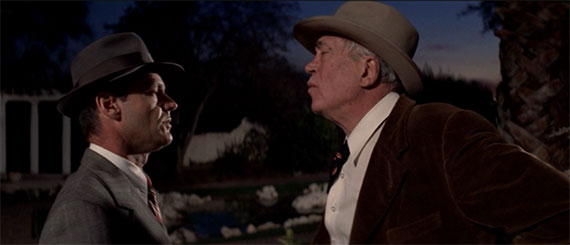
In the middle of this run came Chinatown, a film that seemed to eerily capture the mood and spirit of mid-1970s America. It was, as critics affirm, the product of an ingenious blend of social commentary in the screenplay by Robert Towne, a visual tour de force in technique and visual storytelling by director Polanski, and a showcase of masterful performances by Jack Nicholson, Faye Dunaway, Walter Huston and the rest of the cast.

Additionally, It marked the apex of the New Hollywood movement that began, debatably, with Bonnie and Clyde in 1967 and ended in the early 1980s. According to some film scholars, Chinatown represented the peak period of this movement before the release of Jaws the following year and the dawn of the blockbuster. New Hollywood movement films often explored the grim and dark aspects of human nature and societal constructs, and their themes commonly examined sociocultural dilemmas, often questioning the pursuit of the American Dream as a futile endeavor.

Chinatown was also graced with a talented crew that perfectly complemented the ambitions of such an intelligent film. Cinematographer John Alonzo blended sun-drenched yellows and browns with rich shadings in his deep-space Panavision framing. With the stylized production design and impeccable costuming of the period by Richard Sylbert, and the haunting horn and piano score by Jerry Goldsmith, the look and vibe of 1937 Los Angeles was flawlessly depicted.

The movie was nominated for 11 Academy Awards, with Towne winning for Best Original Screenplay. The American Film Institute ranks Chinatown #19 and then #21 on its 1998 and 2007 lists, respectively, of the top 100 American films ever made; it earns second place on the AFI’s top 10 mystery movies list; and Noah Cross was named the AFI’s 16th best villain of all time.

Today, Chinatown tallies an impressive 98% fresh score on Rotten Tomatoes, where its average critical score is 9.2 out of 10 and its audience score is 93%. At Metacritic.com, it boasts a Metascore of 92 out of 100.

Chinatown inspired several films in its wake. It established that neo-noir was critically and commercially viable as a subgenre, perhaps encouraging subsequent filmmakers to create, like Chinatown, retro noirish works set decades earlier such as Farewell My Lovely (1975) and The Big Sleep (1978, both starring Robert Mitchum), Angel Heart (1987), Miller’s Crossing (1990), Devil in a Blue Dress (1995), and LA Confidential (1997). It also enjoyed a sequel, The Two Jakes (1990), directed by Nicholson himself. Two animated comedies tip their cap to Chinatown: Who Framed Roger Rabbit (1988) and Rango (2011). Brick (2005) draws inspiration from Polanski’s film. Three Hindi films released in India pay homage: Six Feet Under (2007), Sonchiriya (2019), and Raat Akeli Hai (2020). Director Matt Reeves cited Chinatown as an influence when making The Batman (2022). A Chinatown prequel has been in development with Netflix over the last five years, with Towne attached as screenwriter and David Fincher as director. And there were reports that Ben Affleck was going to direct an adaptation of the book The Big Goodbye, about the making of Chinatown, which sounds similar to the approach for The Offer (2022) about the making of The Godfather.

Exemplary direction

To accentuate the voyeuristic perspective of both Gittes and the viewer (seeing through his eyes), Polanski consistently uses subjective camera shots, commonly shooting over Nicholson’s shoulder, especially during driving scenes, or framing Nicholson in profile off to one side of the screen. This does more than merely present a subjective viewpoint. It also suggests Gittes’ impotence—his being ‘boxed in’ a corner in the face of evil or greater numbers—and hints at malevolent forces lurking in the corners, just beyond our field of vision. In this sense, a deep psychological framing is achieved, and a sense of apprehension is evoked with a more menacing off-screen space.

The director shrewdly employs foreshadowing techniques to hint at what’s to come, if you pay close attention. Examples include numerous mentions and imagery of water; Hollis Mulwray, then Gittes, losing a left shoe; sudden car honks that long precede the blaring car horn caused by Evelyn’s dead body at the conclusion; the revealed flaw in Evelyn’s iris, the same eye that is later blown away by a bullet; the object Gittes tries to fish out of the saltwater pond earlier, eventually revealed to be Noah’s bifocals; the car’s steaming radiator outside the window of the barbershop, which the steam emanating from Gittes’ car during the Orange Grove sequence recalls; and the missing left lens of Jake’s sunglasses after getting manhandled by the farmers, similar to the cracked left lens of Noah’s bifocals.

It was Polanski’s nihilistic vision that guided the film fluently along the pessimistic path of noir. Consider his tragic past: the murder of his Polish family members in Nazi Germany decades earlier and the killing of his wife Sharon Tate by the Manson family only five years prior. Perhaps these experiences motivated him, even subconsciously, to imbue the film with a consistently dark tone and prompted him to change the original, more upbeat ending of Towne’s script (in which Evelyn lives and Kathryn escapes to Mexico).

Possibly Polanski’s finest moment is the concluding scene, where all the disparate characters and conflicting forces converge in L.A.’s Chinatown neighborhood. The director fashions this sequence as a subjective experience for the audience, keeping the camera at eye level and maintaining Gittes’ POV as if we are present with him among the bystanders on the street.

Jack’s peak period

Nicholson embodies a multifaceted personality who veers from predictable personalization; unlike Bogart’s Sam Spade or Philip Marlowe, he isn’t two steps ahead of every other character as a master chess-playing gumshoe. The actor expertly plays Gittes as cocky and confident, but his Achilles’ heel is that he refuses to be deceived or outwitted, and he doesn’t realize until it’s too late that he’s in over his fedora. This is a self-assured man who doesn’t suffer fools lightly and enjoys the art of the humorous but corrosive insult, which often results in violent repercussions for him. Nicholson’s shamus can be refined, patient, suave, and sensitive but at other times vulgar, irascible, and vicious, the latter evidenced when he cruelly slaps the truth out of Evelyn. Nicholson deftly balances between these polarities and evinces the portrait of a complex individual—one with a shadowy past only hinted at in this story.

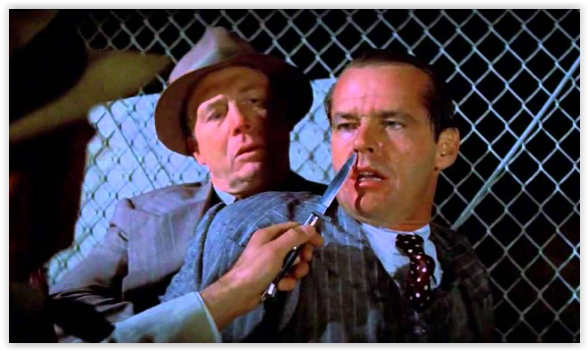
It’s significant that Nicholson is in every scene of the film, which is fitting because Gittes is the true surrogate for the audience; we only learn as much information as he does when he learns it. It’s also astounding that the actor – and the character – spends over one-third of the film either wearing an ostentatious facial bandage or sporting an ugly nose scab. Fortunately for us, Nicholson was no prima donna who refused to look unglamorous.

Roger Ebert wrote: “He can be raw, he can tell dirty jokes, he can accuse people of base motives, but all the time there’s a certain detached underlevel that makes his character sympathetic… Gittes becomes a man who just wants to get to the bottom of things. He’s tired of people’s lies…He doesn’t like being jerked around.”

This was Jack at the peak of his powers, during his incredible run of stellar performances that started with Easy Rider and continued through Five Easy Pieces, Carnal Knowledge, The Last Detail, and his Oscar-winning turn in One Flew Over the Cuckoo’s Nest, all from the late 1960s through 1970s, when he earned five Academy Award nominations in six years.

Masterful storytelling

The original story by Towne could be the best screenplay ever written. The Writers Guild of America ranks it #3 behind only Casablanca and The Godfather. This is a tale that requires more than one viewing to not only fully grasp the intricate plot but also to appreciate how brilliantly the story unfolds and how craftily each scene builds upon what came before. Rewarding small details and foreshadowing easter eggs can be found by those who pay close attention. It’s one of the most intelligent and unpredictable cinematic yarns ever spun, and it represents a lost breed of slow-burn, downbeat, fatalistic, and intricately clever narratives that Hollywood stopped making a long time ago. It was “the last of the great complicated storylines that movies dared,” according to film scholar David Thomson.

Critics regard this story as Towne’s definitive statement, his brilliant apocalyptic vision of a counter-myth to modern capitalist society, with Noah Cross seen as a destructive variation on the narrative of America’s founding fathers. Per film critic Glenn Erickson: “Following in the footsteps of classic noirs that yearned for lost hopes and ideals, Chinatown constructs a noir metaphor for the Garden of Eden. In this case, the Garden has been overrun by the Devil.”

The screenplay is composed in the same formulaic private-eye style of author Raymond Chandler, with Gittes constructed as a contemporary Phillip Marlowe. Towne, however, kept the cynicism of the detective genre intact and further enhanced it with a layered, intricate social critique and a smooth plot pacing that offered one startling revelation after another with clean, perfect precision.

Salon critic Andrew O’Hehir wrote: “The greatness of Chinatown…lies not in its cynical view of the California dream (that’s too easy) but in its fatalistic, even tragic conception of America and indeed of human nature.”

“The exhaustive, labyrinthine narrative is built up like a fortress around this film’s bitter heart. If we place ourselves in his shoes, as a kind of moral crusader, what we end up facing is the emptiness of an all-or-nothing fuck you. It’s the kind of ending Hollywood was able to do at one time without fear, where they could upset the moral compass of the hero in order for the audience to think about their own,” opined Jeremiah Kipp of Slant Magazine.

The dialogue, particularly the caustic remarks and memorable lines by Gittes and Cross, is especially savory. Chinatown is richly abundant with eminently repeatable quotes, including:

“All right, Curly. Enough's enough. You can't eat the Venetian blinds. I just had them installed on Wednesday.”

“Are you alone?” followed by “Isn't everybody?”

“Politicians, ugly buildings, and whores all get respectable if they last long enough.”

“Mrs. Mulwray, I goddamn near lost my nose. And I like it. I like breathing through it. And I still think you're hiding something.”

“You see, Mr. Gittes, most people never have to face the fact that at the right time and the right place, they're capable of anything.”

“As little as possible.”

And, of course: “Forget it Jake, it’s Chinatown.”

Deeper meanings behind the mystery

Crafted with numerous themes and subtexts, Chinatown is an intellectually rewarding piece of cinema. The inescapability of guilt, shame, and past trauma is one key message. Jake, Evelyn, Hollis, Ida, Katherine, and Escobar have skeletons in their closets or dark secrets that come back to haunt them. Chinatown itself exemplifies Jake’s guilt; recall that years ago he had been told by a colleague to do “as little as possible” there, after managing to get an unnamed woman “hurt.” Chinatown represents a place but also a state of mind where the individual is helpless against powerful and unpredictable forces, evil propagates, and inexorable fate awaits.
Chinatown also explores the futility of good intentions and the common man’s ability to thwart evil. The financial power and influence of Cross and his cronies prevent Jake and the police from producing any change or protecting the innocent. Mulwray’s dam causes deaths, the police end up killing Evelyn, and her illegitimate daughter ultimately falls under the clutches of her vile father/grandfather.

Jake proves to be wholly ineffectual and inadvertently responsible for the death of Evelyn, Cross gains custody of Katherine, and Cross presumably succeeds in his plan to control the city’s water and profit from exploiting the farmers’ land. His poor instincts, lack of foresight, and inability to learn from his past failure as a cop in Chinatown result in an even worse tragedy. These examples underscore themes of ignorance and illusion. Consider, too, how Jake misidentifies many clues, such as not recognizing Detective Loach as the person who instructs him to visit Ida Sessions’ house, which sets into motion a series of dominoes leading to Evelyn’s demise. He constructs explanations based on unreliable, limited information and worsens the situation when he trusts his distorted reality. In trying to help Evelyn, he leads her father directly to her.

Additionally, Chinatown is a study on the repercussions of voyeurism and invasion of privacy. The film opens with a client looking at photographs of his wife in bed with another man taken by Gittes. He snaps photos of Hollis Mulwray with another woman together, which inadvertently get published and create a scandal. His telephoto lens and binoculars are used in other scenes, to spy on Evelyn or Hollis from afar. But Gittes’ covert spectatorship and curiosity have violent consequences. His nosiness results in a scar on his olfactory organ, a brutal thrashing from a pack of farmers, a philandering wife receiving a black eye, and a lover losing an eye and her life.

Duality and ironic opposites are in Polanski’s crosshairs, as well. Gittes prides himself on being a savvy private eye, yet he is blind to the truth. Evelyn is both a sister and a daughter to Kathryn. Escobar has a cold in the summertime. Water is abundant, yet there is a drought. Cross’s justification for his manipulation of the water supply is that he’s thinking about “the future”, which he won’t live to enjoy anyway. Saltwater is a life essence for fish but deadly to vegetation and human beings. Cross’ water is both “bad for the grass” and “bad for the glass,” namely Gittes’ ability to see the truth.

Chinatown also explores the American dream usurped by corruption. Consider that Cross pilfers from these dreamers and steals their land and water. This potent patriarch can be seen as a destructive variation on the story of America’s founding fathers. The drought in Los Angeles is transformed into a spiritual thirst, with the malevolent Noah Cross seen as a biblical perversion of his first name. He’s drowned his son-in-law, but he’s also secretly planning to nourish the valley so that a new Eden will emerge.

Basking in the glow of 50 candles

On its golden birthday, Chinatown confers a priceless present to film fans: It proved 50 years ago that noir, even a noir narrative anchored in antiquity, never went out of style. It may not have been the first major instance of neo-noir, but I believe it remains the best example to date of this evolved subgenre or style, however you choose to define it. Chinatown is a fascinating artifact in that, notwithstanding its age, it looks and plays like a more recent movie, as can be said of several period-piece and neo-noir contemporaries from the 1970s like The Godfather and The Godfather Part II, Badlands, Taxi Driver, The Long Goodbye, The Conversation, and The Sting. That’s because it was crafted with intelligence and respect for an intuitive and sophisticated audience, imbued with modern sensibilities, and unafraid to challenge our expectations for a straightforward plot.

The foreboding and pessimism oozing from nearly every pore of Chinatown’s sweaty brow ingeniously upset the viewer’s equilibrium in ways that arguably no classic noir did quite so effectively in the 1940s and 50s. Arrestingly armed with the graphic violence, nudity, and profanity verboten from private eye pictures and cinematic thrillers of the classic period and not beholden to any production code that demanded comeuppance for criminals, this film is responsible for helping noir transition effectively to the modern age. That transition was surely eased with legendary names attached like Nicholson, Dunaway, Huston, Towne, Goldsmith, and, separating the art from the problematic artist, Polanski.

On the noir continuum, Chinatown remains after five decades a momentous pivot point bridging two eras, refusing to atrophy or soften around the edges, ever insisting that rot and decay are just a shallow dig away if you’re determined to look. Jake may want to forget it, but we certainly don’t.

Read more...

  © Blogger template Cumulus by Ourblogtemplates.com 2008

Back to TOP