Blog Directory CineVerse

"Bingo" scores with baseball lovers and movie fans alike

Thursday, May 30, 2013

Yesterday, CineVerse caught all 9 innings of "The Bingo Traveling All-Stars and Motor Kings," a quirky African American baseball comedy from the mid 1970s. Here's a play-by-play recap of our group discussion:

WHAT SURPRISED YOU ABOUT THIS FILM?
·       It takes a very lighthearted, comedic approach to a dark chapter in American sports history: the segregation of white and black baseball players, and doesn’t tackle a lot of the racial undercurrents of that era
·       Good casting: Memorable performances by Billy Dee Williams, James Earl Jones and the scene-stealing Richard Pryor
·       It’s a crossover movie that appeals to all races, not just African Americans, although it overwhelmingly features African American characters
·       It’s a baseball-themed picture, but it’s arguably less a film about the sport and spectacle of baseball than it is about black entrepreneurship and independence
·       As one critic put it, it was “part of two concurrent waves of 1970s cinema: movies about African Americans going into business for themselves (like Car Wash), and movies about the wild side of the first half of 20th century America (like The Sting, The Godfather)

CONSIDERING THAT RACISM AND RACIAL SEGREGATION IS AN IMPORTANT COMPONENT OF THE STORY OF THE NEGRO LEAGUES AND NEGRO BARNSTORMING TEAMS, DO YOU FEEL THAT THE ISSUE OF SYSTEMIC AND INSTRINSIC RACISM IS EXPLORED ENOUGH IN THIS FILM? OR IS THAT TOO DEEP AND DARK A SUBJECT MATTER FOR AN OTHERWISE LIGHTHEARTED FILM?
·       Tonally, this movie is a nostalgic comedy featuring an all-star black cast, so it’s best elements really only need to be laughs and familiar stars
·       Hence, the approach is cheery, light and comical; to delve too deeply into racial subtexts would create a dark, deep drama, and that wasn’t the apparent intent here
·       Nevertheless, considering that so few movies to that time even tackled the topic of the Negro Leagues, and that so little historical footage of negro league players even exists, perhaps the filmmakers had an obligation to address the issue of racial segregation and the difficulties these players faced in white-dominated America

WHAT ARE SOME OF THE THEMES WOVEN INTO BINGO LONG THAT YOU CAN IDENTIFY?
·       The pluck, spirit and determination of the underdog: facing off as an independent against the established order
·       American entrepreneurship: the can-do resolve of a self-made man, no matter the color of his skin
·       Black pride and black power, as not only demonstrated by the characters, but by the African American actors and filmmakers, who included producer Berry Gordy

FILMS THAT REMIND YOU OF “BINGO LONG”
·       The Jackie Robinson Story (1950)
·       42
·       Don’t Look Back: The Story of Leroy ‘Satchel’ Paige (1981 tv movie)
·       The Harlem Globetrotters (1951 movie)

OTHER FILMS BY DIRECTOR JOHN BADHAM
·       Saturday Night Fever
·       Whose Life Is it Anyway?
·       WarGames
·       Stakeout

Read more...

Baseball with soul

Sunday, May 26, 2013

Baseball season is in full swing--what better time to feature "The Bingo Long Traveling All-Stars & Motor Kings” (1976; 110 minutes), directed by John Badham, chosen by Brian Hansen. That's up next in the CineVerse batting order, scheduled for May 29.

Read more...

Notes you can take with you

Friday, May 24, 2013

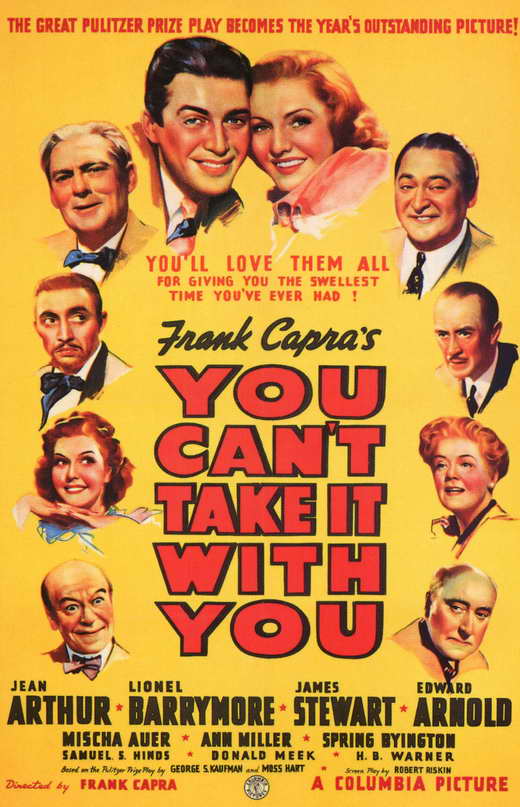
On Wednesday, CineVerse had the pleasure of discussing the merits of Frank Capra's "You Can't Take it With You," which holds up surprisingly well after 75 years. Here's a recap of that group talk:

ARGUABLY, THIS FILM IS LESS ABOUT THE ROMANCE BETWEEN TONY AND ALICE AND MORE OF A STORY ABOUT A DIFFERENT PROTAGONIST. WHO IS THIS PROTAGONIST AND WHAT IS THE PROOF THAT HE IS THE MORE IMPORTANT CHARACTER THAN THE TOP-BILLED LEADS?
·       Tony and Alice aren’t really forced to change; their relationship is challenged by social forces, but there isn’t much conflict or transformation required here
·       Instead, Tony’s father Anthony Kirby is the character who undergoes the most radical evolution, from an avaricious big businessman who ignores his son to a man who recognizes how he’s neglected his relationship with his son and others and is missing out on the fun in life.
·       The catalyst for this change is Grandpa Martin, a kindly patriarch and inspirational optimistic who encourages people to be free spirits.
·       The film’s title, after all, must particularly refer to Kirby, who has the most money of all the characters, and who “can’t take it with him” when he dies.

THEMES EXAMINED IN THIS PICTURE:
·       Think for yourself and follow your true passions
·       Individualism should be valued over corporate gain and big business
·       Money and material possessions can’t buy love or guarantee happiness; family is more important
·       Even the most staunch, stubborn, greedy and opportunistic are capable of change
·       Utopia is possible within a nurturing family and supportive home; utopia is not possible within a system that devalues the individual as a cog in a capitalist machine
o   One critic eruditely extrapolates on this theory, saying that the film suggests how “monopoly capitalism’s success depends on eliminating utopian spaces.”
o   This same critic contends that, in Kirby’s insinuation that the politicians have been bribed to allow him to create a vast monopoly, Capra is infusing a veiled message that he has “doubts about the New Deal’s empowering of the federal government to restrain monopoly capitalism.”

THIS MOVIE WON BEST PICTURE AND DIRECTOR OSCARS FOR 1938 AND WAS HUGELY POPULAR THAT YEAR. BUT HAS IT AGED WELL OVER 75 YEARS?
·       Arguably, it’s a bit long and drawn out, combining elements of screwball comedy and romance with a social message picture that, tonally, can clash a bit
·       It’s not as uproariously funny today as it probably was in 1938
·       It was a soothing film to end-of-the-Depression era audiences and, thus, a product of its times
·       The film has an overly and unreasonably optimistic tone without many shades of gray: love conquers all, goodwill and happiness conquers greed. Today, the movie can appear corny and Pollyannaish.
·       Yet, its basic themes are still relevant today: family and personal happiness is more important than wealth and power; do what you love to do.

OTHER CAPRA FILMS:
·       It Happened One Night
·       Mr. Deeds Goes to Town
·       Lost Horizon
·       Mr. Smith Goes to Washington
·       Meet John Doe
·       It’s a Wonderful Life

WHAT ARE SOME COMMON THEMES THAT RUN THROUGH MOST CAPRA MOVIES?
·       Populist values
·       The struggle of the everyday common man against the machine of politics, commerce, and corruption
·       Man conflicted by alternating realities (consider George Bailey: he has a lust for Violet, a need for Mary; he desires fame and success and to escape the confines of social responsibilities, yet he’s compelled to stay in Bedford Falls, mortgage his dreams to keep a positive cash flow)
·       Strong, charismatic female leads: Jean Arthur in Mr. Smith, Mr. Deeds, You Can’t Take it With You; Stanwyck in John Doe, Colbert in It Happened One Night
·       The masses are like sheep and democracy can be dangerous: consider how easily manipulated people are in Meet John Doe, Mr. Smith Goes to Washington, Mr. Deeds Goes to Town, etc.

FILMS THAT REMIND YOU OF “YOU CAN’T TAKE IT WITH YOU”
·       Mary Poppins: the transformation of the rigid, unattentive father is similar to patriarch Kirby’s transformation
·       The Hotel New Hampshire: another tale about an eccentric family
·       Cheaper by the Dozen: another story about a large family with a quirky patriarch
·       Dinner at Eight: another film depicting a dinner party gone awry

Read more...

A fresh-faced young Jimmy Stewart

Sunday, May 19, 2013

Long before George Bailey (or the Building and Loan) existed, there was Tony Kirby, as played by a young and spry James Stewart, one of the lovable stars in "You Can’t Take it With You” (1938; 126 minutes), directed by Frank Capra, chosen by Norm Omiecinski, and slated for CineVerse on May 22.

Read more...

Life is like a slice of pie...

Tuesday, May 14, 2013

Last week, CineVerse was charmed by the pluck and prettiness of Keri Russell's character in "Waitress." A roundup of our group discussion on this film follows:

HOW IS THIS FILM DIFFERENT FROM WHAT YOU EXPECTED?
·       Yes, it’s a chick flick and a romcom to a great extent, but it’s not as cookie cutter, predictable and cliché as you might expect. Men could easily enjoy this picture as much as women if they give it a chance.
·       It takes turns in plot and character development that you may not have saw coming, and it doesn’t paint with too broad a brush: even the brutish husband Earl is arguably played in a non-caricatured way.
·       It’s not exactly a strong testament to the affirming power of marriage or the joyous expectations of impending motherhood: in this film, seemingly everyone is unfaithful, the lead character is less than excited about having a baby, and she yearns to get away from her abusive husband
·       It would appear at first glance to have overdone, stock characters sampled from TV shows like “Alice” and “Two Broke Girls,” and a sickly sweet downhome charm with the casting of Andy Griffith; however, each character is distinctive and worthy of his/her screen time.
·       It’s a hard film to dislike because you can’t help but root for Jenna in her predicament and her desire for a better life.

CAN YOU IDENTIFY ANY THEMES THAT “WAITRESS” TRIES TO INVESTIGATE?
·       Life doesn’t have to be a dead end if you use your talents, capitalize on opportunities and look at things in a different way.
·       It is possible to start a new life, despite seemingly insurmountable hurdles.
·       We don’t have to conform to what society tells us to do, such as remain in a bad marriage, be perfectly prepared for parenthood, and be happy with the status quo.
·       Life is like a slice of pie: sometimes you’re given a good and fair sized slice, sometimes not

OTHER FILMS THAT COME TO MIND AFTER WATCHING “WAITRESS”
·       The Good Girl, a similar picture about a female caught in a doomed marriage and trying to escape from a rote, dead-end life
·       Chocolat, a romantic comedy that also uses food as a plot device and as a metaphor for life
·       Alice Doesn’t Live Here Anymore, a movie about a waitress sparking a relationship with an exciting new man in her life

Read more...

Meet Maria

Sunday, May 12, 2013

Circle May 15 on your calendar; that's the date for CineVerse's next World Cinema Wednesday special, this time from Columbia: “Maria Full of Grace” (2004; 101 minutes), directed by Joshua Marston, chosen by David Ries.

Read more...

"Waitress" is ready to take your order

Sunday, May 5, 2013

Up next on the CineVerse menu for May 8 is “Waitress” (2007; 108 minutes), directed by Adrienne Shelly, chosen by Danealle Kueltzo. No tip required.

Read more...

Looking back on "Lights"

Monday, April 29, 2013

Recently, CineVerse met to discuss the merits and pleasures of Charles Chaplin's "City Lights." Here's a quick summation of that yak-fest:

WHAT TECHNIQUES DOES CHAPLIN USE TO ENTERTAIN AND HUMOR AUDIENCES?
·       Pantomime: using facial expressions, gestures and body language without words to convey emotions and reactions. Example: The drunken Little Tramp
·       Slapstick: using comically exaggerated and boisterous actions or situations that defy the limits of our physical world for comic effect. Example: Being thrown into the water because the heavy rock is now tied around his body instead of the other man’s body.
·       Using objects that appear as other objects. Examples: the streamers that he thinks are spaghetti; the bald man’s head believed to be a party treat
·       Self-decprecation: many laughs come from the Little Tram trying to maintain his dignity despite his rags, small stature and laughable appearance. Example: the paper boys who tease him and the butler who throws him out of the mansion.
·       Humorous set pieces: self-contained, hilarious vignettes that, when strung together throughout a movie and interwoven with a central plot, help form a finished film. Example: the boxing match

WHAT ARE SOME OF THE QUINTESSENTIAL ELEMENTS OF CHAPLIN’S CLASSIC STYLE THAT HE TENDS TO EMPLOY THROUGHOUT HIS FILMS?
  •        Pathos and sentimentality: his movies are emotionally manipulative
  •        His feature-length films often play out as a series of episodes, sometimes only loosely connected, that can work as mini-movies within the larger film
  •        The universality of the human experience: Chaplin was the master of silent cinema because he didn’t need words or talky exposition to elicit a strong emotional reaction in viewers; consequently, people from around the world who spoke different languages and may have been illiterate as well as young children could understand, appreciate and be entertained by his pictures.
  •        Championing the underdog and the outsider: The Little Tramp character functions as a self-reliant, resourceful misfit who is not accepted in society; he learns to survive, thrive, and earn the companionship he needs through his humanistic qualities as well as quite a bit of sheer luck.

THIS FILM ATTEMPTS TO PLUMB SEVERAL THEMES. ARE ANY EVIDENT TO YOU?
·       The stark contrast between the haves and have-nots and between spiritual wealth and material wealth: characters lacking financial means in this film tend to be more well-rounded and spiritually enriched, while the millionaire, for example, lives a rich but vacuous lifestyle devoid of much meaning. This would have sent a powerful message during the depths of the Great Depression in 1931.
·       Life is worth living: This is the message the Little Tramp teaches both the Millionaire and the blind girl, to whom Chaplin’s character serves as a redeemer and savior.
·       The struggle to see and be seen: The Little Tramp is ignored and overlooked by society, but ironically a blind woman pays attention to him. She can’t see his destitution; she only sees his kindness and compassion.

DOES CITY LIGHTS RECALL ANY OTHER FILMS YOU’VE SEEN?
·       The Strong Man, a 1926 silent feature directed by Frank Capra about a modest man who falls for a blind woman
·       The Bride of Frankenstein, in which a hideous monster is befriended by a blind man
·       Mask, a movie about a teenage boy with a rare facial deformity who is in love with a blind girl
·       The Artist, a throwback film that won the Best Picture Oscar last year and pays homage to silent film comedy romances

Read more...

Bright lights, big city

Sunday, April 28, 2013


On May 1, make plans to join CineVerse for the kickoff to the May/June schedule and the initial installment of a new monthly feature that will continue for the next several months: Triple Talent Pioneers: filmmakers who wrote, directed, produced (and sometimes starred in) their movies.

Up first in this series is City Lights” (1931; 87 minutes), directed by Charles Chaplin, one of the funniest and sweetest movies you will ever see. Plus, following the movie, enjoy an excerpt from a documentary on the brilliant career of Chaplin.

Read more...

  © Blogger template Cumulus by Ourblogtemplates.com 2008

Back to TOP